For many, a credit card is a safety net. But when high-interest debt piles up, the net can become a snare. If you’re struggling to keep up with spiraling payments, you’ve likely considered options from consolidating to extending your EMI plan.
However, for a significant number of individuals, there comes a point where an EMI is just prolonging the pain. That’s when you should seriously consider Credit Card Loan Settlement. It’s a strategic move, not a last resort, that can wipe the slate clean and pave the way for true Debt Planning.
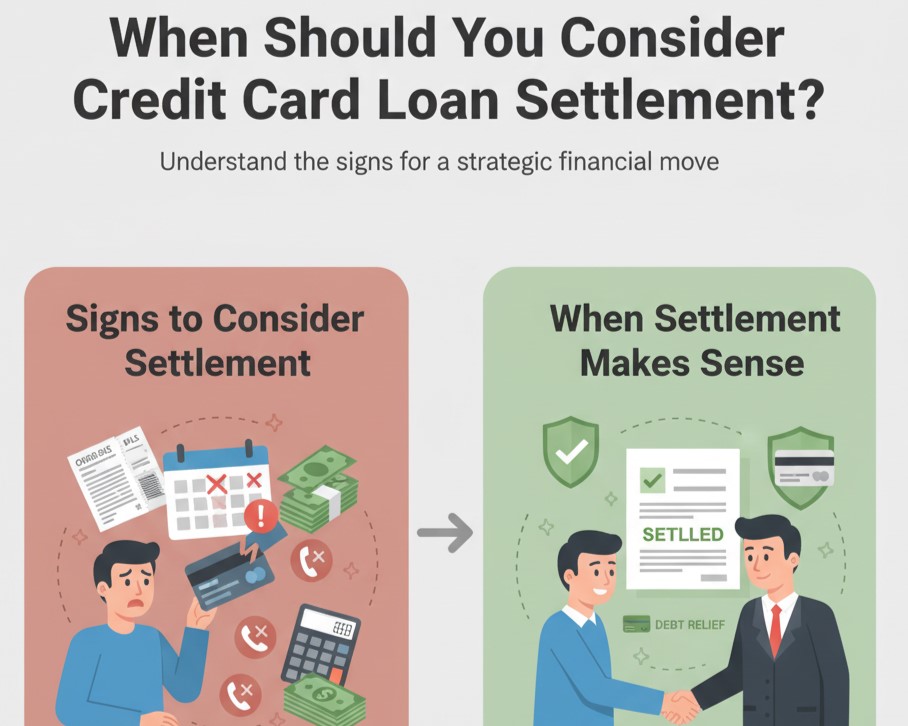
Here are the key signs that signal it’s time to move past temporary fixes and pursue a full debt settlement.
1. Your Minimum Payments Are Not Reducing the Principal
The most frustrating sign of a debt spiral is seeing your massive Credit Card Loan balance barely budge, even when you make your payments on time.
- The Problem: Credit card companies design minimum payments to cover high-interest and fees first. If you are consistently paying only the minimum, the majority of your payment is consumed by interest, leaving the principal balance largely untouched. You are effectively renting the money forever.
- The Signal: If you realize you could pay for a decade and still owe nearly the same amount, the math is broken. Credit Card Loan Settlement allows you to break this cycle by negotiating a lump-sum payment for a fraction of the outstanding principal, offering an actual, final resolution.
2. Your Debt-to-Income Ratio is Unsustainable
A simple financial health check is comparing your debt payments to your income.
- The Problem: Most financial advisors recommend that your total unsecured debt payments (including EMIs) should not exceed 20% of your take-home pay. If your credit card payments alone are creeping toward or exceeding this limit, your budget is choked. You have little to no room for savings, emergencies, or life itself.
- The Signal: When your debt burden makes it difficult to afford basic necessities like rent, food, or medical expenses, you are in financial distress. At this point, no amount of careful budgeting can fix the problem—you need a reduction in the debt itself, not just a rearrangement of payments.
3. You’ve Fallen Seriously Behind on Payments
While settling your debt before you miss a payment is ideal, creditors rarely agree to a significant reduction until they see a genuine risk of loss.
- The Sweet Spot for Settlement: Creditors become most willing to negotiate a lower settlement amount once an account is 90 to 180 days delinquent (past due). At this stage, the account may be deemed a “charge-off,” and the bank will accept a significant loss just to recover some of the funds quickly.
- The Trade-Off: Yes, falling behind severely damages your credit score. However, if your score has already taken a major hit from multiple late payments and high utilization, the additional impact of a settlement may be negligible compared to the benefit of becoming debt-free in a short, fixed period.
4. You Are Considering High-Risk Solutions
Desperation leads to poor financial decisions. The moment you consider these options, you need to stop and look at Credit Card Loan Settlement instead:
- Using Cash Advances: Taking a cash advance from one credit card to pay the EMI on another is a classic sign of a debt spiral. Cash advances have high fees and sky-high interest rates, making your problem worse instantly.
- Raiding Retirement Accounts: Liquidating a 401(k), PF, or other retirement savings to pay a credit card is often a permanent mistake. The lost funds are subject to taxes and penalties, and you forfeit decades of future compound growth.
5. Your Debt Is the Result of an Unforeseen Crisis
Life happens. Job loss, medical emergency, or a business failure can instantly make a manageable EMI plan impossible.
- The Leverage: Creditors and settlement specialists often view debt resulting from a genuine crisis more favorably. This financial hardship is the leverage you need to argue for a substantial reduction, as it clearly demonstrates a permanent change in your ability to repay the full amount.
Conclusion: Debt Settlement as Strategic Debt Planning
Credit Card Loan Settlement is not about avoiding responsibility; it’s about taking back control through effective Debt Planning. It allows you to trade a heavily damaged credit score (which can be rebuilt) for a definitive, debt-free future.
If your financial reality matches the signs above, stop making minimum payments that only feed the interest monster. It’s time to talk to a professional to determine your settlement potential and start the journey to a debt-free life.
Don’t wait until you’re completely out of options. Get expert help for your Credit Card Loan Settlement today.