
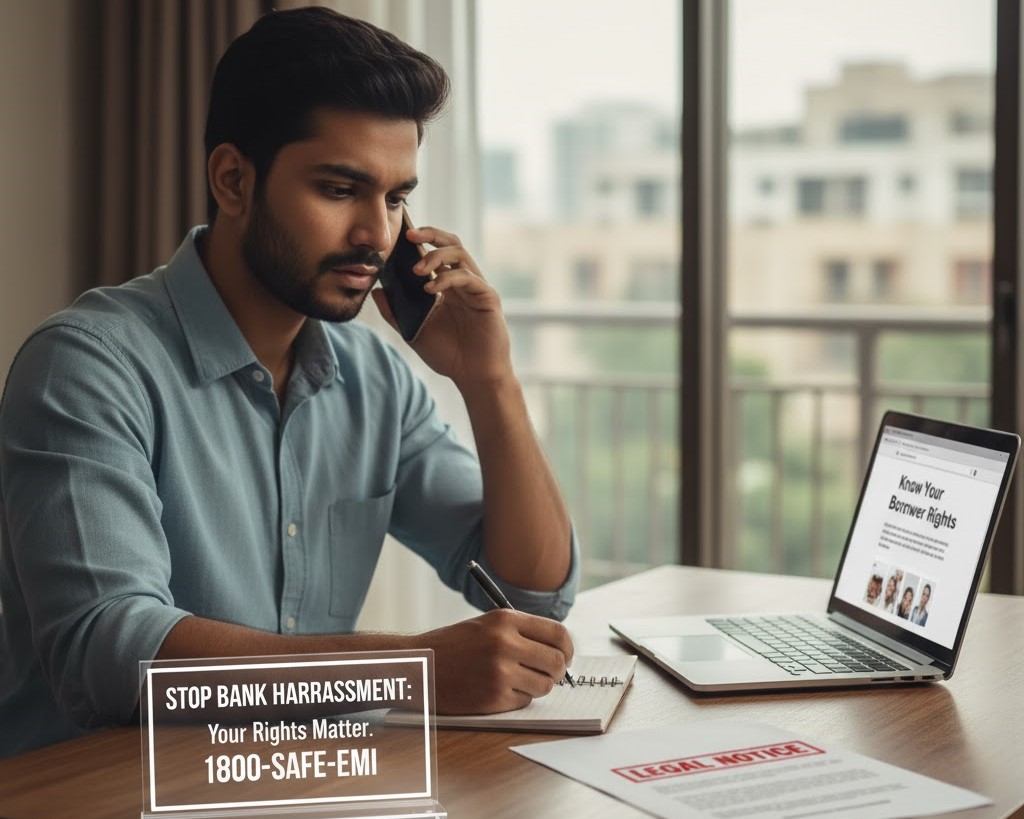
Facing constant, aggressive, or ill-timed calls from a bank or its recovery agents can be one of the most stressful experiences during financial difficulty. It’s crucial to remember this: You have the right to be treated with dignity and respect, regardless of your loan status.
In India, the Reserve Bank of India (RBI) has laid down strict rules to protect borrowers. Any violation of these rules is a serious matter, and you are not powerless.
At Settle Loan, our Anti-Harassment Service is built on empowering you to regain control and settle your loan on your terms. Here is the best way to legally and effectively deal with bank harassment calls.
Step 1: Know Your Rights – The RBI Shield
Before you act, understand the rules that recovery agents are legally bound to follow. Any deviation is considered harassment and gives you a strong case.
If a caller violates any of these, immediately terminate the call, document the incident, and proceed to the next step.
Step 2: Document Everything (Your Evidence is Your Shield)
Documentation is the single most important step. Without proof, your complaint is just your word against the bank’s.
- Maintain a Harassment Log: Keep a detailed, running record for every harassing call or visit:
- Date and Time of the call/visit.
- Phone Number of the caller (personal or landline).
- Agent Name (if provided).
- Exact Nature of Harassment (e.g., abusive language, called after 7 PM, discussed debt with a relative, threatened legal action/arrest).
- Record Conversations: If permissible in your state, record the conversation. If you are recording, it is a good practice to politely inform the caller that the conversation is being recorded for legal purposes.
- Save Messages: Preserve all abusive SMS, WhatsApp messages, or emails as evidence.
Step 3: Take Formal Action – The Complaint Hierarchy
You must follow the official grievance hierarchy to force the bank to take action and build a strong legal record.
1. File a Complaint with the Bank’s Grievance Redressal Cell (First Port of Call)
- Write a formal, detailed letter or email to the bank’s designated Grievance Redressal Officer.
- Clearly state the issue, mention the specific dates/times from your log, and attach any evidence.
- Demand that the bank immediately cease and desist all harassing communication and take action against the offending agent/agency.
- Keep a copy of your complaint and proof of submission. The bank is generally mandated to respond within 30 days.
2. Escalate to the RBI Integrated Ombudsman Scheme (If the Bank Fails)
If the bank does not resolve your complaint to your satisfaction within 30 days, or if the harassment continues, escalate the matter to the RBI’s Integrated Ombudsman Scheme (RB-IOS).
- This is a free-of-cost dispute resolution mechanism designed to address “deficiency in service,” which includes harassment.
- You can file a complaint online on the RBI’s Complaint Management System (CMS) portal.
3. File a Police Complaint (For Severe Cases)
For cases involving physical threats, criminal intimidation, explicit verbal abuse, or trespass, you must file a First Information Report (FIR) with your local police station under relevant sections of the Indian Penal Code (IPC).
Settle Loan’s Anti-Harassment Service: Taking the Legal High Ground
While dealing with harassment, your focus should be on resolving the underlying debt. This is where professional legal support provides the most leverage.
- Immediate Legal Notice: We draft and issue a formal Legal Notice (Cease-and-Desist) to the bank’s legal department. This formally demands that all harassing contact must stop immediately, signalling your intent to pursue litigation. This step alone often ends the calls overnight.
- Professional Negotiation: Once the harassment stops, you are in a much stronger position. Our experts take over all communication, ensuring a respectful and professional environment to negotiate a fair resolution, such as a One-Time Settlement (OTS) or a loan restructuring.
- Legal Security: We ensure that your final debt resolution is legally sound and fully documented, protecting you from future claims.
Don’t Suffer in Silence. Reclaim Your Peace of Mind.
Being in debt is a financial situation, not a crime. You deserve to be treated with dignity. Let Settle Loan help you stop the harassment and move towards a peaceful, legal resolution of your loan.