
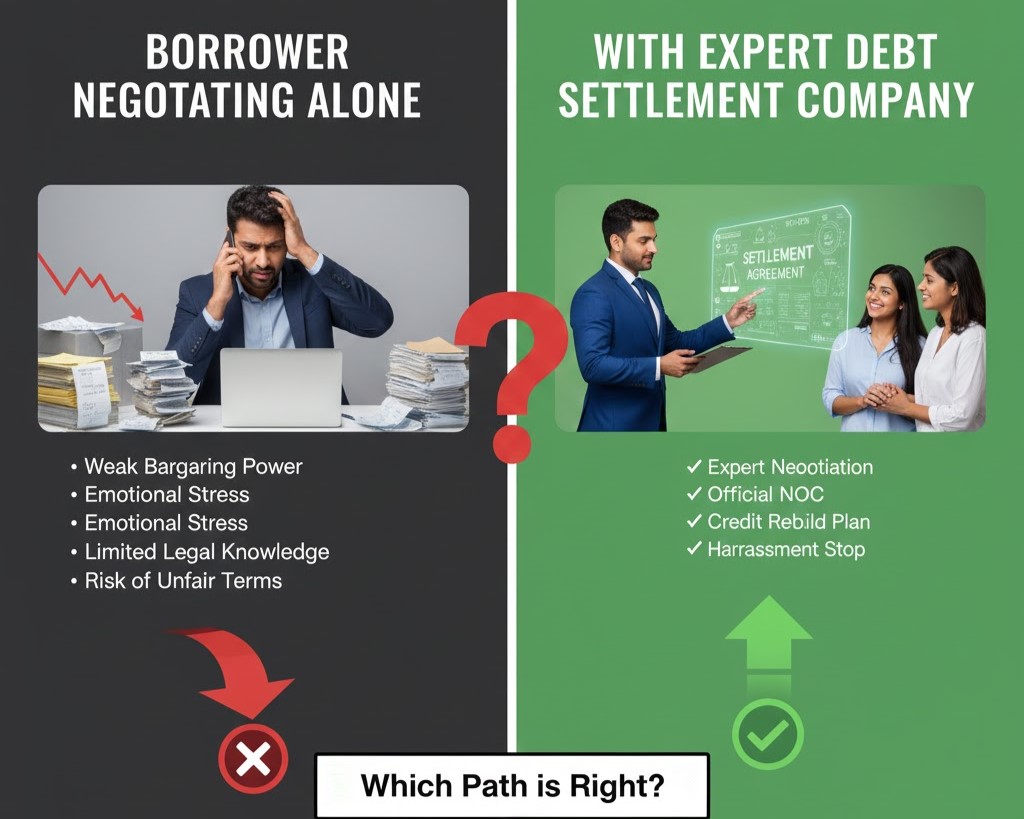
When you are facing a defaulted loan, securing a favorable Debt Settlement requires specialized skill, legal knowledge, and an understanding of the bank’s internal processes. This is where professional Debt Settlement Companies prove their value.
They don’t just ask the bank for a discount; they engage in a strategic bank negotiation process designed to maximize your loan relief by leveraging specific financial and legal triggers.
Here is a step-by-step breakdown of how these companies approach negotiations to achieve the lowest possible settlement value for you.
1. Building the Case: Financial and Legal Assessment
The negotiation begins long before the first call is made. A professional firm uses a structured approach to build a rock-solid case for the largest possible waiver.
-
Financial Deep Dive: The company analyzes your entire financial profile, focusing on your current income, expenses, and asset liquidity. They calculate the maximum you can pay—this becomes the final target settlement value.
-
Proof of Hardship: They identify and compile the necessary supporting documentation (job loss letters, medical bills, business closure proof) that legally justifies the bank’s decision to offer loan relief. Banks require this paper trail to defend the write-off internally.
-
Understanding the Bank’s Floor: They determine how far the bank is realistically willing to drop the debt. This “floor” is often dictated by the loan’s status (how long it has been a Non-Performing Asset or NPA), the bank’s provisioning norms, and the legal costs the bank would incur through prolonged litigation.
2. Strategic Timing and Formal Offer
Timing and the formality of the offer are critical factors that influence bank negotiation.
-
The Waiting Game: Debt Settlement Companies rarely negotiate on accounts that are only 30 or 60 days overdue. They often wait until the loan is firmly classified as an NPA (90+ days overdue) or even “Written-Off” internally. This timing is strategic because the bank has already accounted for the loss and is focused solely on maximizing recovery quickly.
-
The Formal Request: The company sends a professionally drafted, formal Loan Settlement Letter to the bank’s authorized collections or legal department (not the field agent). The letter clearly states the lump sum offer and demands the waiver of all accrued interest, penalties, and future charges.
3. The Negotiation Strategy: Leveraging the Pain Points
The actual bank negotiation is a strategic process of back-and-forth, not simple haggling.
-
Threat of Litigation Cost: The expert panel reminds the bank that pursuing full recovery through legal channels (DRT, SARFAESI) is time-consuming and expensive. The potential cost of litigation, coupled with the uncertainty of recovery, makes accepting a fair settlement financially appealing to the bank.
-
Lump Sum Power: The company stresses that their offer is a guaranteed, immediate lump sum. Banks prefer a definite, quick recovery over uncertain, long-term legal processes.
-
Refusing Unreasonable Demands: The company pushes back professionally on high initial counter-offers, using the documented financial hardship as the constant justification for the lower figure, securing a better settlement value.
4. Finalizing and Securing Legal Documentation
The negotiation is not complete until the paperwork is secure. This is where Debt Settlement Companies provide crucial legal support.
-
Conditional Acceptance: They ensure that once an agreement is reached, the bank issues a Loan Settlement Letter on their official letterhead. The company rigorously checks this letter to confirm it explicitly states the payment is for “full and final satisfaction” of the debt.
-
No Payment Without Paperwork: They strictly advise the borrower never to pay the final lump sum until the correct legal documentation is received, safeguarding the borrower’s position.
-
Securing the NDC: After payment, the company actively follows up to ensure the bank promptly issues the No Dues Certificate (NDC), which is the final legal proof of debt closure.
By managing these complex steps, Debt Settlement Companies leverage legal and financial facts to secure the maximum loan relief possible, transforming a stressful debt crisis into a clean, strategic exit.
Ready to start your professional bank negotiation?
Contact Us today for a consultation with our experts to secure your lowest possible settlement value.