
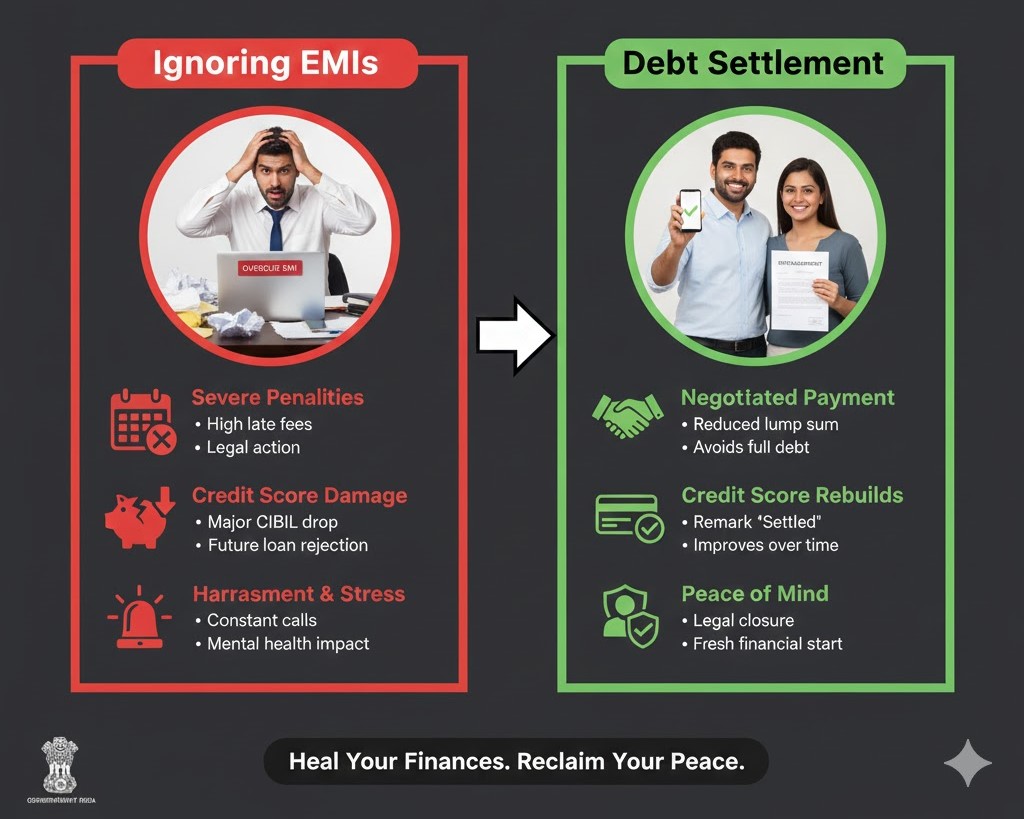
When financial hardship hits, many borrowers initially panic and resort to the worst possible strategy: ignoring EMIs and hoping the problem will somehow disappear. This avoidance is financially toxic.
While Debt Settlement involves serious consequences (like a hit to your credit score), it is a controlled, definitive recovery strategy. Ignoring your payments, conversely, is an uncontrolled slide into legal disaster and long-term financial ruin.
Here is why choosing Debt Settlement is always the better, smarter, and ultimately faster path to debt closure than allowing the EMI default to spiral out of control.
1. Debt Settlement is a Controlled Action; Ignoring is Total Surrender
| Feature | Debt Settlement (Controlled Action) | Ignoring EMIs (Total Surrender) |
| Final Debt Amount | Reduced to a settlement value (e.g., 50-70% of outstanding). | Debt grows exponentially due to high penalties and compounding interest. |
| Legal Status | Ends the debt permanently with a No Dues Certificate (NDC). | Leads directly to legal action, potential wage garnishment, or asset seizure. |
| Stress | Ends after a few months with debt closure. | Ongoing, mounting stress from collection calls and legal threats for years. |
| Credit Report Status | Marked as “Settled” (Severe negative, but defined). | Marked as “Default,” “Written-Off,” or “Charge-Off” (Maximal negative, showing total failure). |
2. The Ticking Time Bomb: The Cost of Ignoring Debt
The consequences of simply ignoring your debt compound rapidly beyond the original EMI default:
-
Penalty Charges: Lenders levy hefty late payment fees, often 2% to 5% of the EMI amount, plus penalty interest on the outstanding balance. Your debt grows faster than you can imagine.
-
Legal Escalation: After 90 days of missed payments, the loan becomes a Non-Performing Asset (NPA). The lender initiates formal recovery action, which may include civil lawsuits, action under the Negotiable Instruments Act (for cheque bounces), or repossession of secured assets (like property or vehicles).
-
Maximum Credit Damage: A settlement results in a negative “Settled” mark. Ignoring the debt leads to the most damaging statuses (“Written-Off” or “Default”), which signals to every future lender that you failed to pay any amount, guaranteeing loan rejection for seven years.
3. Debt Settlement Provides a Clear Finish Line
The single biggest benefit of debt settlement is that it provides a specific, achievable goal: pay the lump sum and you are free.
-
Negotiated Relief: You leverage your financial hardship to negotiate a manageable settlement value. The bank accepts the reduced amount to cut its losses and close the account.
-
Legal Certainty: Once the payment is made and you receive the No Dues Certificate (NDC), the debt is legally extinguished. All recovery action, legal or otherwise, must cease immediately and permanently.
-
The Rebuilding Starts Now: While the “Settled” status hurts, the clock on your financial recovery starts the moment the debt is closed. You can immediately begin focusing on saving, budgeting, and patiently rebuilding your creditworthiness without the shadow of the old debt hanging over you.
The decision is clear: Debt Settlement is a deliberate, proactive step that stops the bleeding and gives you back control. Ignoring an EMI default is a guarantee of escalating debt, severe legal issues, and maximal damage to your future.
Ready to take control and stop the financial spiral?
Contact Us today to turn your EMI default into a definitive debt settlement and start your financial recovery.