
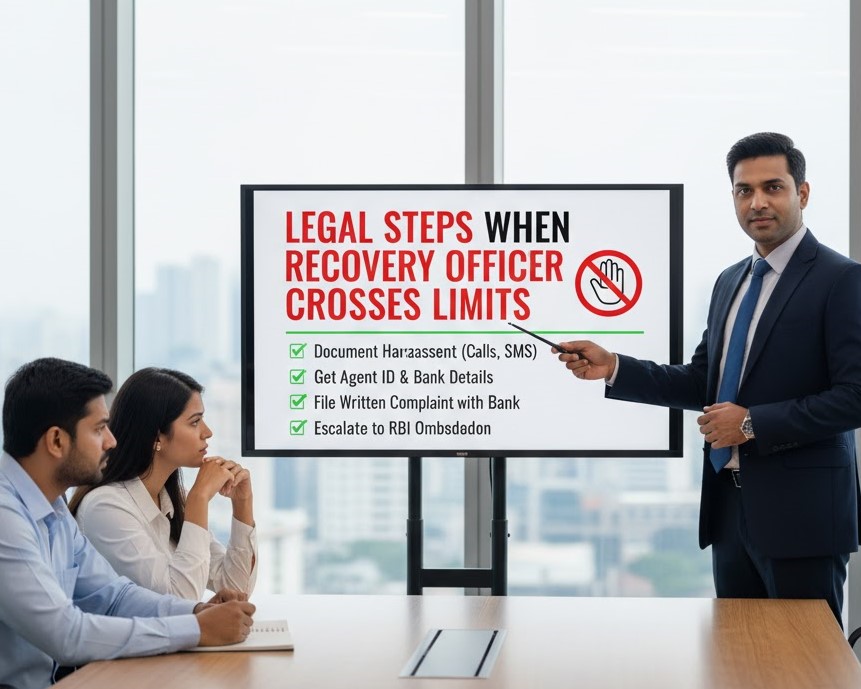
When financial difficulties lead to loan default, the stress can be immense. Unfortunately, many borrowers also face unethical and illegal tactics from bank recovery officers, commonly referred to as Bank Harassment. This includes threats, public shaming, abusive language, and calls outside prescribed hours.
It is vital to know that you are not helpless. The Reserve Bank of India (RBI) has stringent rules protecting borrowers. Taking swift, legal action against unethical collection practices is the most powerful step you can take to stop the abuse and force the bank to negotiate a resolution like a Settle Loan professionally.
1. Step 1: Document the Harassment (Your Legal Evidence)
Before you can file a complaint, you must build an irrefutable case.
| What to Document | Why it Matters |
| Date, Time, & Location | Proves violations of the RBI’s 7:00 AM to 7:00 PM contact window. |
| Recovery Agent’s Identity | Name, phone number, and the recovery agency’s name. Demand their ID if they visit. |
| Specific Violations | Record the exact threatening words, abuses, or illegal actions (e.g., “I will get you arrested,” “I told your neighbor you are a defaulter”). |
| Proof | Save threatening text messages/WhatsApp chats. If permissible in your location, record the call after informing the agent. |
2. Step 2: File a Formal Complaint with the Bank
You must give the bank a chance to rectify the issue internally.
- Target the Grievance Redressal Officer (GRO): Send a detailed email or registered post to the bank’s Grievance Redressal Officer (GRO) or the Principal Nodal Officer. Their contact details are mandatory on the bank’s website.
- Demand Action: Attach your harassment log and clearly state that the agent’s actions violate the RBI’s Fair Practices Code. Demand immediate cessation of the harassment and action against the officer.
- Time Limit: The bank is typically obligated to respond to your complaint within a specified timeframe (usually 30 days).
3. Step 3: Escalate to the Regulatory Authority (RBI Ombudsman)
If the bank fails to respond within 30 days or the harassment continues after their response, immediately escalate the matter.
- The Power Move: File a complaint with the RBI Integrated Ombudsman Scheme (via the CMS portal). This is the regulator’s highest authority.
- Attach Everything: Submit your original complaint to the bank, the bank’s inadequate response (or lack thereof), and your detailed harassment log.
- The Result: The RBI takes these violations very seriously and can impose heavy penalties on the bank, forcing the immediate removal of the offending agents and opening the door for professional resolution.
4. Step 4: Police Action (For Extreme Criminal Threats)
For severe cases involving physical threats, criminal intimidation, or trespassing, involve law enforcement.
- File an FIR: Immediately file a First Information Report (FIR) at your local police station against the recovery agent and the agency.
- Cite IPC Sections: You can cite sections of the Indian Penal Code (IPC) related to criminal intimidation (Section 506), trespassing, or mischief. A police report is a powerful deterrent against further illegal activity.
Taking these legal steps is essential not just for justice, but for leveraging your position. A bank facing a formal complaint for Bank Harassment is far more likely to agree to a professional Loan Settlement to close the account and remove the regulatory risk.