
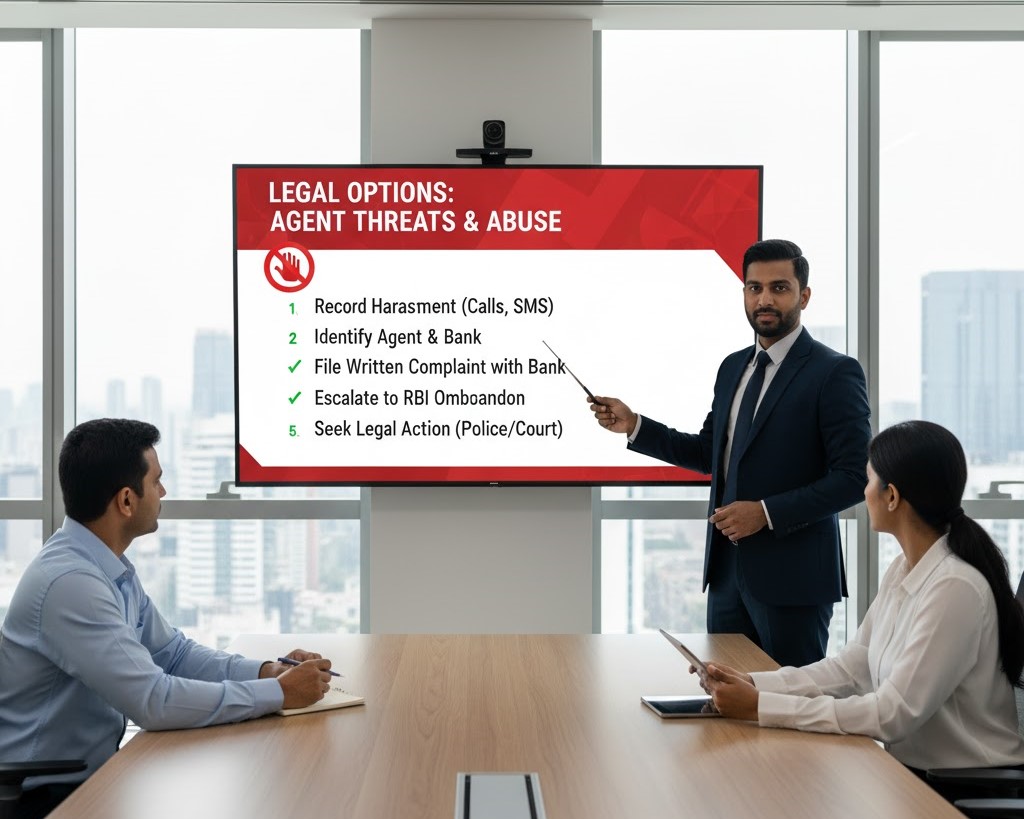
When financial difficulty forces you to explore options like a Loan Settlement, the process should be dignified and professional. Unfortunately, aggressive recovery agents often cross legal and ethical limits, subjecting borrowers to threats and abuse (Agent Harassment).
It is crucial to know that this aggressive behavior is illegal. The law, spearheaded by the Reserve Bank of India (RBI), provides a powerful arsenal of legal steps you can take to stop the abuse, hold the bank accountable, and force a professional resolution, such as a Settle Loan.
1. Step 1: Document Everything (Your Evidence is Your Weapon)
Before taking any formal action, you must build an irrefutable legal case. Every instance of threatening or abusive behavior must be recorded.
| What to Document | Why it Matters | Legal Protection Violated |
| Date, Time, & Location | Proves violation of the RBI’s strict 7:00 AM to 7:00 PM contact window. | RBI Fair Practices Code |
| Agent’s Identity | Note their name, phone number, and the agency name. Demand their ID and authorization letter. | Identification Requirement |
| Specific Violations | Record the exact abusive language, threats of violence, or illegal actions (e.g., “I will get you arrested,” threats to family). | Criminal Intimidation (IPC) |
| Proof | Save all threatening texts/WhatsApp messages. Consult a lawyer about recording calls to use as evidence. | Evidence Act |
2. Step 2: Formal Complaint to the Lender (The Mandatory First Step)
The bank/NBFC is legally responsible for the actions of its recovery agents. You must formally notify them of the misconduct.
- Target the GRO: Send a detailed email or registered post to the lender’s Grievance Redressal Officer (GRO) or Principal Nodal Officer.
- Demand Action: Attach your detailed harassment log and demand immediate cessation of the aggressive contact and action against the agent/agency.
- Response Time: The lender is obligated to respond to your complaint within a stipulated timeframe (typically 30 days).
3. Step 3: Escalate to the Regulator (The Ultimate Leverage)
If the harassment continues or the lender fails to resolve the issue satisfactorily within the response time, escalate the matter to the RBI.
- The RBI Ombudsman: File a complaint with the RBI Integrated Ombudsman Scheme (RB-IOS) via their online CMS portal.
- The Power: RBI treats Agent Harassment as a serious regulatory offense and can impose heavy penalties or even ban the bank from using recovery agents in a specific area. This regulatory threat is often the quickest way to force the bank to seek a professional Settle Loan agreement to close the account.
4. Step 4: Police Action (For Criminal Threats)
When the abuse involves criminal intimidation, physical threats, or illegal trespassing, immediate police intervention is required.
- File an FIR: Immediately file a First Information Report (FIR) at your local police station against the recovery agent and the agency they represent.
- Cite IPC Sections: Lawyers can help you cite relevant sections of the Indian Penal Code (IPC), such as:
- Section 503: Criminal Intimidation (threats of harm/injury).
- Section 509: Insulting the modesty of a woman.
- Section 441: Criminal Trespass (illegal entry).
- Civil Injunction: If police action is slow, you can file a Civil Injunction Suit in court to get a stay order preventing the agent from visiting or contacting you.
Taking these structured legal steps is essential not just for justice, but for leveraging your position. By legally cornering the bank over Agent Harassment, you force the conversation away from aggression and toward a professional, dignified Settle Loan resolution.