
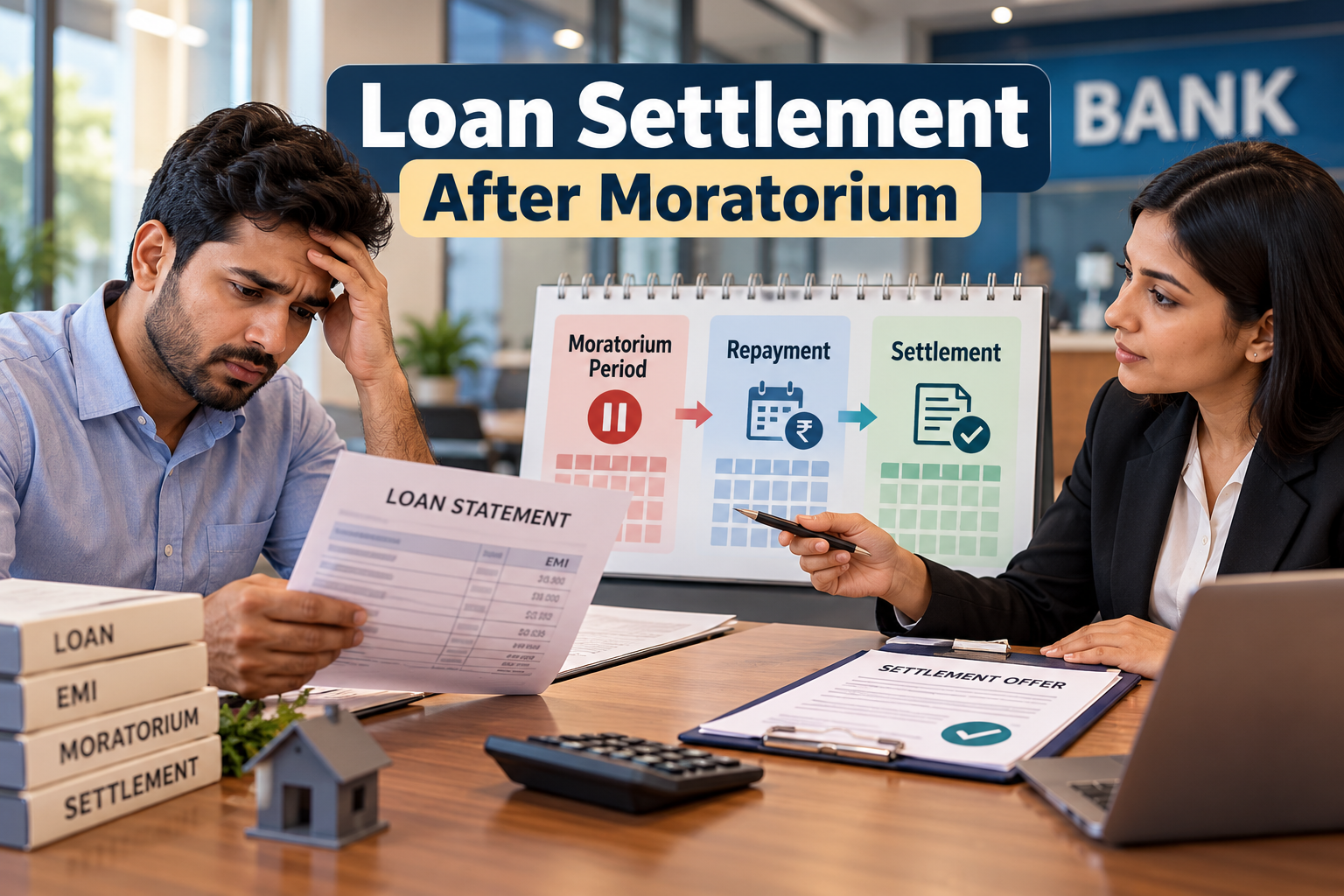
A loan moratorium gives a borrower temporary relief from scheduled repayment obligations, but it does not normally cancel the loan. When the moratorium ends, the borrower remains responsible for the outstanding loan according to the applicable loan terms or revised arrangement.
If the borrower is still facing serious financial difficulty after the moratorium, Loan Settlement After Moratorium may be considered in some cases. However, settlement is not an automatic right. A bank or NBFC decides whether to consider a compromise settlement based on its applicable policy, the loan account, financial circumstances, repayment history, outstanding amount, security, and recovery prospects.
A moratorium and settlement serve different purposes. A moratorium provides temporary repayment relief, while settlement is a negotiated resolution of an outstanding claim that may involve the lender accepting less than the full contractual dues.
Therefore, reaching the end of a moratorium does not automatically mean that the borrower must settle the loan. Depending on the circumstances, options may include resuming regular EMIs, discussing restructuring or another repayment arrangement, or requesting a settlement when the debt has become genuinely difficult to repay.
This article explains what happens after a moratorium, when settlement may be considered, how it differs from restructuring, what documents may help, and what borrowers should understand about credit reporting and future borrowing.
Quick Answer
Can you settle a loan after a moratorium?
Yes, a lender may consider settlement after a moratorium if the borrower is facing genuine financial difficulty and the account meets the lender’s applicable settlement criteria. However, a moratorium does not create an automatic right to settlement.
Does a moratorium cancel the loan?
No. A moratorium generally provides temporary repayment relief. The treatment of interest, repayment schedule and outstanding amount depends on the specific relief or restructuring arrangement.
Should you settle immediately after the moratorium ends?
Not necessarily. If your income has recovered and you can afford the revised EMI, normal repayment or another repayment arrangement may be preferable. Settlement should be evaluated when the debt remains genuinely unsustainable.
Moratorium and Loan Settlement Are Not the Same
One of the most common misunderstandings is treating a moratorium as a form of debt waiver.
They are different.
A loan moratorium generally means that scheduled payments are deferred or otherwise modified for a specified period under the applicable arrangement.
A loan settlement is a negotiated resolution in which the lender agrees to accept a specified amount to settle its claim, potentially involving a sacrifice or waiver of part of the amount otherwise due.
For example, suppose a borrower has a personal loan and receives a six-month repayment relief arrangement.
At the end of those six months, the borrower may still have a substantial outstanding balance.
If the borrower’s income has recovered, regular repayment may resume.
If the borrower is still unable to service the loan, the borrower may approach the lender to discuss available resolution options.
Settlement is therefore a separate decision.
Why Borrowers Take a Moratorium
A moratorium is usually relevant when a borrower experiences temporary cash-flow pressure.
Possible reasons include:
- Temporary job loss
- Salary reduction
- Business disruption
- Medical expenses
- Temporary income interruption
- Unexpected family expenses
- Other short-term financial stress
The underlying assumption is that repayment capacity may improve later.
But sometimes the financial problem does not end when the moratorium ends.
A borrower may still have:
- Reduced income
- High household expenses
- Existing debt
- Unemployment
- Business losses
- Increased financial obligations
- Insufficient savings
This is where the borrower needs to reassess the entire debt position rather than simply waiting for the next EMI demand.
What Happens When the Moratorium Ends?
The exact outcome depends on the arrangement provided by the lender.
The borrower may be required to resume repayment according to the applicable schedule or revised terms.
The first step should be to obtain updated loan information.
Check:
- Current principal outstanding
- Interest accumulated or applicable
- Revised EMI
- Remaining tenure
- Overdue amount, if any
- Charges
- Current account status
- Any revised repayment terms
Do not rely on the original EMI figure if the loan terms were modified during the relief period.
The borrower should understand the current liability before deciding whether to repay, restructure, or explore settlement.
Can You Settle a Loan Immediately After a Moratorium?
Potentially, yes, but timing alone does not guarantee eligibility.
A lender may examine the borrower’s actual financial condition.
For example, a borrower who has restarted employment with a stable salary may have a reasonable path to regular repayment.
Another borrower may still be unemployed and have no realistic ability to maintain the EMI.
These two cases should not be treated identically.
A strong settlement request should therefore explain the continuing financial difficulty rather than simply state:
“My moratorium is over, so I want a settlement.”
The important question is:
Why is normal repayment still not realistically affordable?
When Does Settlement Become Relevant?
Settlement may become relevant when the borrower has a continuing financial problem and the debt cannot reasonably be serviced under the existing arrangement.
Possible situations include:
Long-Term Unemployment
The borrower expected to return to work during the moratorium but remains unemployed.
Permanent or Significant Income Reduction
The borrower has returned to work but earns substantially less than before.
Business Income Has Not Recovered
A self-employed borrower may continue to face weak cash flow after temporary relief ends.
Multiple Debts Have Become Unsustainable
The moratorium may have provided temporary relief on one loan while other liabilities continue to consume the borrower’s income.
Major Financial Emergency
A serious family or financial event may have permanently changed repayment capacity.
These circumstances do not guarantee settlement.
They provide context for discussing available resolution options with the lender.
Loan Settlement vs Loan Restructuring
This is one of the most important distinctions after a moratorium.
Loan Restructuring
Restructuring generally changes the terms of repayment because the borrower is experiencing financial difficulty.
Depending on the lender and applicable framework, changes can involve repayment period, instalments, interest or other terms.
The borrower remains responsible for repaying the debt under the revised arrangement.
Loan Settlement
Settlement is different.
A lender may agree to resolve its claim for an agreed settlement amount, potentially involving a sacrifice of part of the amount otherwise due.
The account is then handled according to the settlement terms and applicable reporting requirements.
Therefore:
Restructuring focuses on making repayment more manageable.
Settlement focuses on resolving a debt through a negotiated compromise.
If the borrower can realistically repay under revised terms, it may be worth discussing those options before choosing settlement.
What Does RBI Say About Compromise Settlement?
The Reserve Bank of India has a specific framework for compromise settlements and technical write-offs for regulated entities.
Under the RBI’s June 8, 2023 framework, regulated entities are required to maintain Board-approved policies for compromise settlements. The framework defines compromise settlement as a negotiated arrangement to fully settle the lender’s claims against the borrower in cash, potentially involving a sacrifice of part of the amount due.
This is important because it shows that compromise settlement is a recognised resolution mechanism.
But it does not mean that every borrower can demand settlement.
The actual decision remains subject to the lender’s applicable policy and the circumstances of the individual account.
There is also no universal RBI rule saying:
“After a moratorium, a borrower can settle the loan at 50%.”
Borrowers should be cautious about such claims.
Can a Moratorium Be Followed by Restructuring?
In some situations, a borrower may discuss restructuring or another resolution arrangement with the lender after temporary relief ends.
RBI’s prudential framework recognises restructuring as a concession granted by a lender for economic or legal reasons relating to the borrower’s financial difficulty. The framework can involve changes to repayment terms and other loan conditions.
The appropriate option depends on the borrower’s actual financial condition.
A temporary problem may call for a repayment adjustment.
A long-term inability to repay may require a different resolution strategy.
What If the Borrower Defaults After the Moratorium?
A borrower should not assume that the moratorium protects the account indefinitely.
If scheduled payments become overdue after the relief period, the account can enter the lender’s normal collection and asset-classification processes according to applicable rules and the loan arrangement.
Continued default can lead to:
- Overdue amounts
- Collection communication
- Additional financial costs according to applicable terms
- Credit reporting consequences
- Escalation of recovery activity
- Potential legal action depending on the loan and circumstances
The exact consequences depend on the lender, loan type, account status and applicable law.
This is why borrowers should communicate early rather than simply stop responding after the moratorium.
Does Loan Settlement Affect CIBIL?
It can.
A borrower who has already missed payments may have experienced an impact on their credit history before settlement is considered.
Settlement itself can also become relevant to future credit assessment because the account’s manner of resolution can be reflected in credit information reported by lenders to Credit Information Companies.
However, there is no responsible way to promise a fixed CIBIL score reduction or recovery amount.
Credit scores depend on the borrower’s broader credit history and the applicable scoring model.
After resolution, borrowers should focus on:
- Checking credit reports
- Ensuring information is factually correct
- Paying future credit obligations on time
- Keeping credit utilisation manageable
- Avoiding unnecessary new debt
A borrower should understand Loan Settlement and CIBIL Score together rather than treating settlement as the end of the financial problem.
Example: Personal Loan After a Moratorium
Consider Rahul, who had a personal loan with a monthly EMI of ₹25,000.
He lost his job and received temporary repayment relief.
During the moratorium, he expected to find new employment.
Six months later, Rahul found a new job, but his salary was ₹38,000 instead of his previous ₹65,000.
His household expenses are ₹25,000 per month, and he also has another credit obligation.
The original EMI is no longer realistically affordable.
Rahul should not immediately assume that settlement is the only answer.
He should first obtain the updated loan statement and ask the lender about available repayment options.
If a manageable arrangement is possible, he can evaluate it.
If the debt remains unsustainable despite genuine financial hardship, he can discuss settlement.
The important point is that the moratorium did not itself create the settlement.
The continuing financial difficulty is what makes a resolution discussion relevant.
Example: Business Loan After a Moratorium
Consider a small business that received temporary repayment relief when revenue dropped sharply.
After the relief period, sales remain weak.
The business owner now has:
- Business loan EMI
- Supplier payments
- Employee expenses
- Rent
- GST and statutory obligations where applicable
- Other business liabilities
If the owner simply starts missing EMIs without communicating with the lender, the financial problem can become harder to manage.
The business should prepare a realistic cash-flow position and discuss available options.
For borrowers dealing with wider business debt, Business Loan Settlement may be relevant, but restructuring or another resolution mechanism may also need consideration.
What Documents Should You Prepare?
A borrower discussing settlement after a moratorium should keep current and supporting documents organised.
Depending on the case, these may include:
- Latest loan statement
- Loan account number
- Bank statements
- Salary slips
- Employment termination documents
- Current income proof
- Business financial records
- Existing loan statements
- Evidence of major financial hardship
- Medical documents where relevant
- Previous lender correspondence
- Moratorium or repayment-relief communication
The purpose is not to create a dramatic story.
It is to demonstrate the borrower’s actual financial position.
Never submit false documents to improve the chance of settlement.
How to Approach the Lender
A practical approach is more useful than simply demanding a discount.
Step 1: Get the Current Loan Position
Find out exactly how much is outstanding.
Step 2: Calculate Actual Affordability
Prepare a realistic monthly budget.
Step 3: Identify Why the Problem Continues
Explain why the borrower remains unable to resume normal repayment after the moratorium.
Step 4: Ask About Available Options
Discuss repayment, restructuring where available, and settlement.
Step 5: Do Not Promise an Unaffordable Amount
A settlement offer is useful only if the borrower can actually arrange the required funds.
Step 6: Obtain Written Terms
Never rely solely on a telephone conversation.
Step 7: Verify Payment Instructions
Use authorised lender channels.
Step 8: Preserve All Records
Keep settlement letters, payment receipts, emails and statements.
This creates a documented Debt Settlement process rather than an informal verbal arrangement.
What Should a Settlement Letter Clearly Mention?
Before making a substantial settlement payment, review the written document carefully.
Look for:
- Correct borrower name
- Correct loan account number
- Total settlement amount
- Payment schedule
- Final payment date
- Conditions
- Consequences of missed payment
- Treatment of remaining dues
- Account closure or resolution terms
- Applicable documentation after payment
If there are co-borrowers, guarantors, collateral or legal proceedings, the relevant position should also be understood.
Do not assume that the words “settlement approved” automatically answer every legal or financial question.
Common Mistakes After a Moratorium
Mistake 1: Assuming the Moratorium Was a Waiver
A moratorium generally provides temporary relief. It does not automatically eliminate the debt.
Mistake 2: Waiting Until Multiple EMIs Are Missed
If repayment is clearly unaffordable, early communication may provide more options.
Mistake 3: Choosing Settlement Without Checking Restructuring
A borrower should compare available options rather than focusing only on the immediate discount.
Mistake 4: Believing Settlement Automatically Repairs CIBIL
Credit recovery is a separate process.
Mistake 5: Paying Based on a Verbal Promise
Always obtain written settlement terms.
Mistake 6: Taking Another Expensive Loan to Fund Settlement
This can simply replace one unaffordable debt with another.
Mistake 7: Believing There Is a Fixed RBI Settlement Percentage
The RBI does not prescribe one universal settlement percentage for all borrowers.
Mistake 8: Ignoring Lender Notices
A settlement discussion does not automatically cancel formal notices or legal deadlines.
Is Settlement Better Than Continuing the Loan?
There is no universal answer.
The decision depends on the borrower’s financial position.
Consider three situations.
Situation A: Income Has Recovered
Regular repayment may be realistic.
Settlement may not be necessary.
Situation B: Income Has Reduced but Repayment Is Still Possible
A revised arrangement, if available, may be worth exploring.
Situation C: Long-Term Financial Hardship Continues
Settlement may become a more relevant resolution option if the lender is willing to consider it.
The right question is not:
“How much discount can I get?”
It is:
“Which available resolution leaves me in the most sustainable financial position?”
Expert Tips for Borrowers After a Moratorium
Do Not Wait for a Crisis to Become a Legal Problem
If you already know that the EMI is unaffordable, start reviewing your options early.
Separate Temporary Problems From Permanent Problems
A three-month income disruption is different from a long-term loss of repayment capacity.
Calculate Total Debt, Not Just One EMI
A loan may look manageable in isolation but become unaffordable when combined with credit cards, personal loans, business obligations or family expenses.
Keep Negotiations Documented
Use email or other traceable communication where possible.
Do Not Focus Only on the Settlement Amount
Look at credit consequences, payment deadlines, future borrowing and total household affordability.
Get Professional Advice for Complex Cases
Where substantial amounts, secured assets, guarantees, legal notices or multiple creditors are involved, case-specific legal or financial advice may be appropriate.
A Simple Decision Framework
Before requesting Settle Loan assistance or approaching a lender, ask yourself:
Can I afford the EMI now?
If yes, normal repayment may be possible.
If not, is my income problem temporary?
If yes, ask about available repayment relief or restructuring.
Is my financial difficulty long-term?
If yes, examine all realistic debt-resolution options.
Can I arrange a settlement amount without creating another unaffordable debt?
If no, the settlement proposal may not be financially workable.
Will settlement affect my future borrowing plans?
Potentially, yes. Consider the credit consequences.
Do I understand the written settlement terms?
If no, do not rush to make payment.
Frequently Asked Questions
1. Can I settle my loan after the moratorium period ends?
A lender may consider settlement after a moratorium if the borrower continues to face genuine financial difficulty and the account qualifies under the lender’s applicable policy. A moratorium does not guarantee settlement. The lender may consider repayment history, current outstanding amount, financial circumstances, recovery prospects and other account-specific factors.
2. Does a loan moratorium reduce the total loan amount?
Not necessarily. A moratorium generally provides temporary repayment relief rather than automatically reducing the principal debt. The financial treatment during the moratorium depends on the specific arrangement. Borrowers should obtain an updated statement after the relief period and verify the outstanding balance, interest treatment, revised EMI and remaining tenure.
3. Can I request settlement before defaulting after a moratorium?
You can communicate your financial difficulty and ask the lender about available options before the situation becomes worse. However, a settlement is not automatically available simply because the borrower expects difficulty. Lenders assess accounts according to their policies and applicable regulatory framework. Early communication can help clarify whether repayment or another resolution is possible.
4. Is loan restructuring better than settlement after a moratorium?
It depends on your financial position. If you can realistically repay the debt under revised terms, restructuring or another repayment arrangement may be worth evaluating. Settlement may become more relevant when the debt remains genuinely unaffordable over the longer term. Compare total repayment cost, credit implications and future affordability before deciding.
5. Does settling a loan after a moratorium affect CIBIL?
It can. Missed payments may already have affected the credit profile, and the manner in which the account is ultimately resolved can also be relevant to future credit assessment. The exact score impact cannot be predicted with a fixed number. After settlement, review your credit reports and ensure that reported information is factually accurate.
6. Does RBI guarantee loan settlement after a moratorium?
No. RBI recognises compromise settlement as a resolution mechanism under its applicable framework, but it does not give every borrower an automatic right to settlement after a moratorium. Regulated lenders operate under their approved policies and consider individual account circumstances. Be cautious of anyone claiming that RBI guarantees a particular settlement percentage.
7. What happens if I cannot pay the EMI after the moratorium?
If you cannot resume repayment, contact the lender and explain your financial position instead of simply ignoring the account. Depending on the circumstances, available options may include repayment arrangements, restructuring where applicable, or settlement discussions. Continued non-payment can lead to overdue status, credit consequences and further recovery activity.
8. Can I settle a personal loan after a moratorium?
A personal loan may potentially be settled if the lender is willing to consider a compromise settlement and the account meets applicable criteria. The borrower should first understand the current outstanding amount and financial hardship. Settlement should be compared with other available options because it can have consequences for future credit assessment.
9. Can a business loan be settled after a moratorium?
A business borrower may discuss available resolution options with the lender when financial stress continues after temporary repayment relief. Depending on the circumstances, restructuring, settlement or another resolution mechanism may be considered. The business should prepare updated cash-flow information and understand the effect on guarantees, collateral, working capital and future borrowing.
10. Can I take another loan to pay the settlement amount?
You should be cautious. A new loan may help fund the settlement but can create another monthly obligation. Before borrowing, calculate the new EMI, interest cost, existing debts, stable income and essential expenses. If the new borrowing remains unaffordable, the settlement may only transfer the financial problem from one account to another.
Conclusion
A moratorium can give a borrower valuable breathing space, but it does not automatically solve the underlying debt problem.
When that period ends, the borrower should reassess the financial position instead of assuming that settlement is either guaranteed or impossible.
If income has recovered, regular repayment may remain the simplest path.
If repayment is possible only with revised terms, discussing restructuring or another available arrangement may make sense.
If the borrower continues to face serious and long-term financial hardship, Loan Settlement After Moratorium may be considered as one possible debt-resolution route, subject to the lender’s decision and applicable framework.
The most important step is to understand the current account position before making any commitment.
Check the outstanding amount.
Review the revised repayment terms.
Assess actual income and expenses.
Understand the difference between restructuring and settlement.
Consider the impact on your credit history.
And if a settlement is offered, read the written terms carefully before making payment.
A moratorium should be treated as an opportunity to reassess the debt, not as a reason to postpone the problem until recovery becomes more difficult.
Need Help With Loan Settlement After a Moratorium?
If your loan moratorium has ended and you are still struggling with repayment, the next step should be based on your actual financial position rather than a fixed settlement percentage.
Settle Loan can help borrowers understand Loan Settlement, Debt Settlement, settlement negotiations and the financial implications of resolving an unaffordable loan.
If credit recovery is also a concern, you can explore Credit Score Builder guidance after resolving the account.
For personalised assistance regarding your loan situation, use Contact Us.