
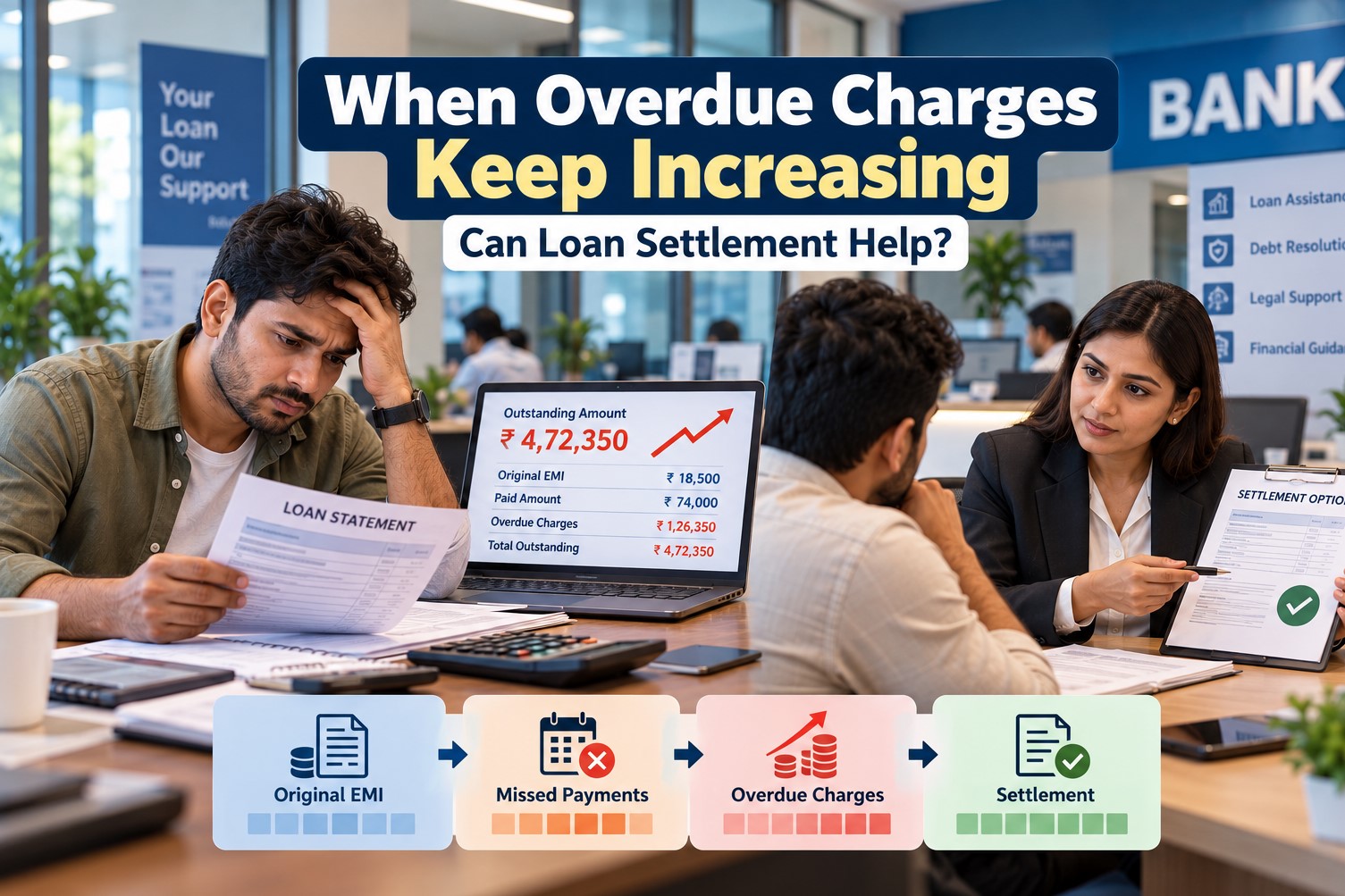
When a loan remains unpaid for a long period, the amount payable can become much higher than the EMI the borrower originally planned for. Interest may continue to accrue, while applicable overdue charges or penal charges can increase the total outstanding amount. In such a situation, a borrower may consider loan settlement if regular repayment is no longer realistically affordable.
Loan settlement means reaching a negotiated agreement with the lender to close the outstanding liability by paying an agreed settlement amount, subject to the lender’s approval and applicable policies. It is not an automatic reduction of the loan and does not mean that overdue charges are simply cancelled. The lender evaluates the account, repayment history, financial hardship and recovery position before deciding whether settlement can be offered.
Before choosing this route, borrowers should check whether repayment, restructuring or another mutually agreed repayment arrangement is possible. They should also understand the effect of settlement on their credit history, future borrowing and any legal or recovery proceedings connected with the account.
Why Does a Loan Become Much More Expensive After Default?
The original EMI is calculated according to the loan amount, interest rate, tenure and repayment schedule agreed at the beginning of the loan.
Once payments are missed, the account can move into overdue status. Depending on the loan agreement and applicable regulatory requirements, additional amounts may become payable. These can include:
- Unpaid instalments
- Accrued interest
- Applicable penal charges
- Other permitted charges
- Legal or recovery-related costs, where applicable
- Other contractual dues
This creates an important distinction: the EMI and the total amount required to regularise an overdue account are not necessarily the same thing.
For example, suppose a borrower originally had a monthly EMI of ₹18,000. After an income disruption, the borrower misses several payments. By the time the borrower tries to regularise the account, the amount required may include multiple unpaid EMIs and applicable charges.
The borrower may then feel that the original EMI burden has become manageable only in theory because the accumulated overdue amount has become much larger.
Can You Settle a Loan When Overdue Charges Have Become Too High?
Yes, a borrower may request loan settlement when accumulated dues have become difficult to repay, but settlement is not a legal right or automatic entitlement.
The lender decides whether to consider a compromise or settlement based on its internal policy, the borrower’s financial circumstances, the account’s status and applicable regulatory requirements.
A settlement discussion can become relevant when:
- The borrower has suffered a significant and continuing income reduction.
- Employment has been lost or income has become irregular.
- A business has experienced a sustained decline in cash flow.
- Multiple loans have created an unsustainable repayment burden.
- The borrower has already missed several payments.
- The total amount required to regularise the account is beyond the borrower’s realistic repayment capacity.
- The borrower has made genuine attempts to resolve the account but cannot maintain the required repayment schedule.
However, a borrower should not assume that high interest or overdue charges alone guarantee a settlement.
The key question is whether the borrower can realistically repay the outstanding liability and what resolution the lender is prepared to approve.
Overdue Charges and Penal Interest: What Should Borrowers Check?
Borrowers often see a large outstanding figure and assume that every additional amount has been added correctly. That should not be taken for granted.
Before discussing settlement, obtain an updated statement from the lender and check:
- Principal outstanding
- Accrued interest
- Overdue instalments
- Penal charges, where applicable
- Other applicable fees
- Payments already made
- Current outstanding amount
- Account status
- Any legal or recovery action mentioned by the lender
The Reserve Bank of India has issued regulatory requirements concerning penal charges and their disclosure by regulated entities. The exact treatment can depend on the type of lender, product and applicable regulatory framework.
Therefore, borrowers should rely on the lender’s account statement and applicable loan documentation instead of calculating the settlement amount based only on the original EMI.
A Large Outstanding Amount Does Not Automatically Mean Settlement Is the Best Option
This is one of the most important points for borrowers.
Suppose someone borrowed ₹6 lakh and has already repaid ₹2.5 lakh. After a period of financial difficulty, the account becomes overdue and the outstanding amount increases.
The borrower may think:
“The charges have increased so much that I should settle immediately.”
That conclusion may be premature.
Before requesting loan settlement, compare at least three possible routes:
1. Regular repayment
If income has recovered, continuing repayment may allow the borrower to close the loan without moving to settlement.
2. Restructuring or revised repayment arrangement
Depending on the lender and applicable framework, a borrower facing financial difficulty may ask whether a restructuring or revised repayment arrangement is available.
This could involve changes to repayment terms rather than closing the liability through a negotiated settlement.
3. Settlement
If the borrower has a genuine inability to repay the full contractual dues and the lender is willing to consider a compromise, settlement may become one possible resolution.
The correct option depends on the borrower’s actual financial position, not simply the size of the overdue charges.
When Does Loan Settlement Become More Relevant?
Settlement becomes more relevant when the financial problem is structural rather than temporary.
For example, consider two borrowers.
- Borrower A lost a job for three months but has now joined a new company with similar income. The borrower can potentially restart repayments after discussing the overdue amount with the lender.
- Borrower B lost a business, has irregular income, has several outstanding debts and cannot reasonably meet the accumulated dues even after reducing household expenses.
The second situation may provide stronger grounds for discussing a negotiated resolution, although the lender still makes the final decision.
This is why borrowers should document their financial hardship rather than simply saying that the loan is unaffordable.
What Evidence Can Support a Settlement Discussion?
A lender may require information that helps it understand the borrower’s repayment capacity and financial position.
Depending on the case, useful documents may include:
- Latest loan statement
- Bank statements
- Salary slips
- Employment termination or income-reduction proof
- Income tax records, where relevant
- Business financial records
- Proof of business closure or reduced revenue
- Other loan statements
- Credit card outstanding statements
- Medical or emergency expense documents, where relevant
- Previous communication with the lender
The purpose is not to create an artificial reason for settlement. It is to present an accurate financial picture.
How Should You Approach the Lender?
A settlement discussion should be handled carefully.
Start by obtaining the current account position. Then calculate how much you can genuinely arrange without taking another unaffordable loan.
A borrower should avoid making a payment commitment merely because the recovery team is asking for an immediate amount.
Instead, ask for the proposal in writing and check:
- Settlement amount
- Payment deadline
- Instalment structure, if permitted
- Conditions attached to the settlement
- Treatment of remaining dues
- Account closure or settlement status
- Effect on any legal proceedings
- Treatment of collateral or guarantor obligations, where applicable
- Documentation that will be issued after payment
The borrower should retain every payment receipt, email, letter and settlement document.
What Is the Difference Between Loan Settlement and Restructuring?
These two options are often confused.
Restructuring generally changes the terms of repayment so that the borrower can continue servicing the liability under revised conditions, subject to the lender’s policy and applicable regulatory framework.
Settlement, on the other hand, involves a negotiated arrangement under which the lender agrees to accept a specified amount to resolve the claim, subject to the terms of the settlement.
In simple terms:
- Restructuring focuses on making repayment workable.
- Settlement focuses on resolving the outstanding claim through a negotiated amount.
Neither should be treated as a guaranteed solution.
A borrower who can realistically repay under revised terms may want to explore that option before moving toward settlement.
What Does RBI Say About Compromise Settlements?
The Reserve Bank of India issued its framework on compromise settlements and technical write-offs in June 2023. The framework recognises compromise settlement as a negotiated arrangement where the regulated entity may agree to settle its claims for an amount different from the total amount due, subject to its Board-approved policy and applicable requirements.
This does not mean RBI sets one settlement percentage for every borrower.
Banks and other regulated entities have their own approved policies and assessment processes. Therefore, claims such as “RBI allows every borrower to settle at 50%” should not be relied upon.
The exact settlement terms depend on the lender, account, circumstances and applicable policy.
Can Overdue Charges Be Waived During Settlement?
They may be considered as part of a negotiated resolution, but borrowers should not assume that all penalties, interest or charges will be waived.
A settlement proposal can involve negotiation over the amount payable, but the final terms depend on the lender.
For this reason, never calculate your expected settlement amount using a fixed percentage found online.
For example, if the outstanding amount shown by the lender is ₹8 lakh, it does not mean that a borrower can automatically offer ₹4 lakh and expect the account to close.
The lender may accept, reject or propose a different amount based on its assessment and policy.
What Happens to Your CIBIL Report After Loan Settlement?
Loan settlement can affect a borrower’s credit history.
Credit Information Companies receive account information from their reporting members. When an account is resolved through settlement rather than repayment of the full contractual dues, the reported status can reflect that settlement arrangement.
This can influence how future lenders view the borrower’s credit history.
Therefore, borrowers should not think of settlement as simply a cheaper way to close a loan.
The immediate objective may be to resolve an unaffordable liability, but the longer-term consequences for access to credit should also be considered.
After settlement, borrowers can work on financial recovery through disciplined repayment of new obligations, controlled credit use and timely payments. A structured Credit Score Builder approach can help with rebuilding credit habits over time.
Practical Example: Personal Loan With Accumulated Overdues
Consider an employee who took a personal loan with an EMI of ₹20,000.
After losing employment, the borrower misses several EMIs. Later, a new job is found, but monthly income is significantly lower than before. The borrower now has to manage rent, household expenses, another credit card balance and the overdue personal loan.
The lender’s demand includes accumulated dues and applicable charges.
The borrower has two problems:
- The original EMI is difficult to maintain.
- The accumulated overdue amount is even more difficult to clear.
Instead of ignoring the lender, the borrower can obtain the latest statement and ask whether any repayment arrangement or restructuring is available. If full repayment remains unrealistic, the borrower can ask whether the lender has a formal settlement process.
If a settlement is offered, the borrower should verify the terms in writing before making payment.
This is where professional Personal Loan Settlement guidance can help a borrower understand the financial and documentation requirements.
What If Recovery Calls Continue During the Overdue Period?
Missing payments can result in collection and recovery activity according to the lender’s procedures and applicable rules.
A borrower should not respond by ignoring every communication.
Instead:
- Keep communication records.
- Ask for account details in writing.
- Verify the identity of the caller.
- Request official payment channels.
- Do not share sensitive banking information with an unverified person.
- Do not make cash payments to an unauthorised individual.
- Escalate inappropriate conduct through the lender’s official grievance process where necessary.
If the issue involves repeated or improper recovery conduct, borrowers can separately understand their rights through Recovery Agent Harassment guidance.
Common Mistakes Borrowers Make
Waiting until the account becomes more difficult to resolve
Ignoring overdue notices does not remove the liability. Delay can make the financial situation harder to manage.
Assuming every additional charge is negotiable
Some amounts may be governed by the loan agreement and applicable regulations. Do not assume that every charge will disappear during settlement.
Taking another expensive loan to fund settlement
Borrowing from another high-cost source can replace one financial problem with another. The total cost and repayment capacity should be assessed first.
Accepting a verbal settlement
A borrower should insist on formal documentation from the authorised lender or entity handling the account.
Believing settlement automatically improves CIBIL
Settlement may have adverse credit-history implications. It should be treated as a debt-resolution decision, not a credit-score repair method.
Assuming RBI fixes one settlement percentage
There is no universal RBI-approved settlement percentage applicable to every borrower and every loan.
Ignoring legal notices
If a borrower receives a court notice, arbitration communication, Lok Adalat notice or another formal legal document, it should not be ignored merely because settlement discussions are underway.
A Practical Decision Test Before You Settle
Ask yourself five questions:
- Can I afford the original EMI now?
If yes, regular repayment may need to be considered before settlement. - Has my financial difficulty genuinely continued?
Temporary cash-flow pressure and long-term inability to repay are different situations. - Have I checked restructuring or another repayment arrangement?
Do not assume settlement is the only available route. - Can I arrange the proposed settlement amount without creating another unaffordable debt?
A settlement funded by expensive borrowing can create another problem. - Do I have the settlement terms in writing?
Never rely only on a phone conversation or informal promise.
These questions can help a borrower make a more informed decision.
Documents to Keep After Settlement
Once a settlement is completed, retain:
- Settlement letter
- Payment receipts
- Bank transaction proof
- Final account statement
- Correspondence confirming the arrangement
- Documents relating to any legal proceeding
- NOC or other applicable closure documentation
- Updated credit report after sufficient reporting time
Borrowers should also check whether the credit information has been updated accurately.
If the information reported by the lender appears incorrect, the borrower can raise a dispute through the appropriate lender and Credit Information Company channels.
Frequently Asked Questions
1. Can I settle my loan if overdue charges have become very high?
You can request settlement, but the lender decides whether to approve it. High overdue charges do not automatically create a right to settlement.
2. Does loan settlement remove all overdue interest and penalties?
Not necessarily. The final settlement amount depends on the lender’s approved policy and the negotiated terms. Any reduction or waiver should be clearly documented.
3. Is loan settlement possible before the loan becomes a long-term default?
A borrower can ask the lender about available resolution options at different stages of financial difficulty. The lender decides which option is applicable to the account.
4. Is restructuring better than settlement?
They serve different purposes. Restructuring generally aims to make continued repayment possible, while settlement aims to resolve the claim through a negotiated arrangement. The appropriate option depends on the borrower’s financial circumstances.
5. Will settling an overdue loan affect my CIBIL report?
It can affect credit reporting because settlement is different from repayment of the full contractual dues. Borrowers should understand the reporting implications before accepting a settlement.
6. Does RBI guarantee loan settlement at a fixed percentage?
No. There is no single settlement percentage guaranteed by RBI for all borrowers. Regulated entities follow their applicable policies and regulatory requirements.
7. Can I negotiate the settlement amount with the lender?
A borrower can request and negotiate a settlement, but the lender is not required to accept the borrower’s proposed amount.
8. Should I take another loan to pay the settlement amount?
This should be approached cautiously. The interest rate, repayment capacity and total cost of the new borrowing should be evaluated before using another loan to resolve the existing one.
9. What should I do if the lender refuses settlement?
Ask whether restructuring, revised repayment or another formal resolution option is available. If you receive a legal notice, take appropriate professional advice rather than ignoring it.
10. Can a personal loan be settled after several missed EMIs?
A personal loan may be considered for settlement if the lender’s policy permits it and the lender agrees to the proposal. The borrower’s financial hardship and account status can form part of the assessment.
11. Will paying a settlement amount immediately close my loan?
Not automatically. Closure depends on compliance with the written settlement terms and the lender’s confirmation. Always obtain formal documentation after completing the agreed payment.
Final Thoughts
When penalties, overdue interest and unpaid instalments make a loan substantially harder to repay, loan settlement can be one possible debt-resolution route. But settlement should not be treated as an automatic waiver of charges or a guaranteed discount.
The first step is to understand exactly what you owe. Obtain the latest statement, separate principal from interest and applicable charges, assess your present repayment capacity and ask the lender about available resolution options.
If regular repayment or restructuring is realistic, those options should be evaluated. If genuine and continuing financial hardship makes full repayment unrealistic, a formal settlement discussion may become relevant.
The most important point is to make the decision using the actual account position, written settlement terms and long-term financial consequences, including credit reporting.
For borrowers who need help understanding their options, Loan Settlement and Debt Settlement guidance can help structure the next steps, documentation and lender communication. If recovery conduct is creating a separate problem, borrowers can also review Bank Harassment support options.