
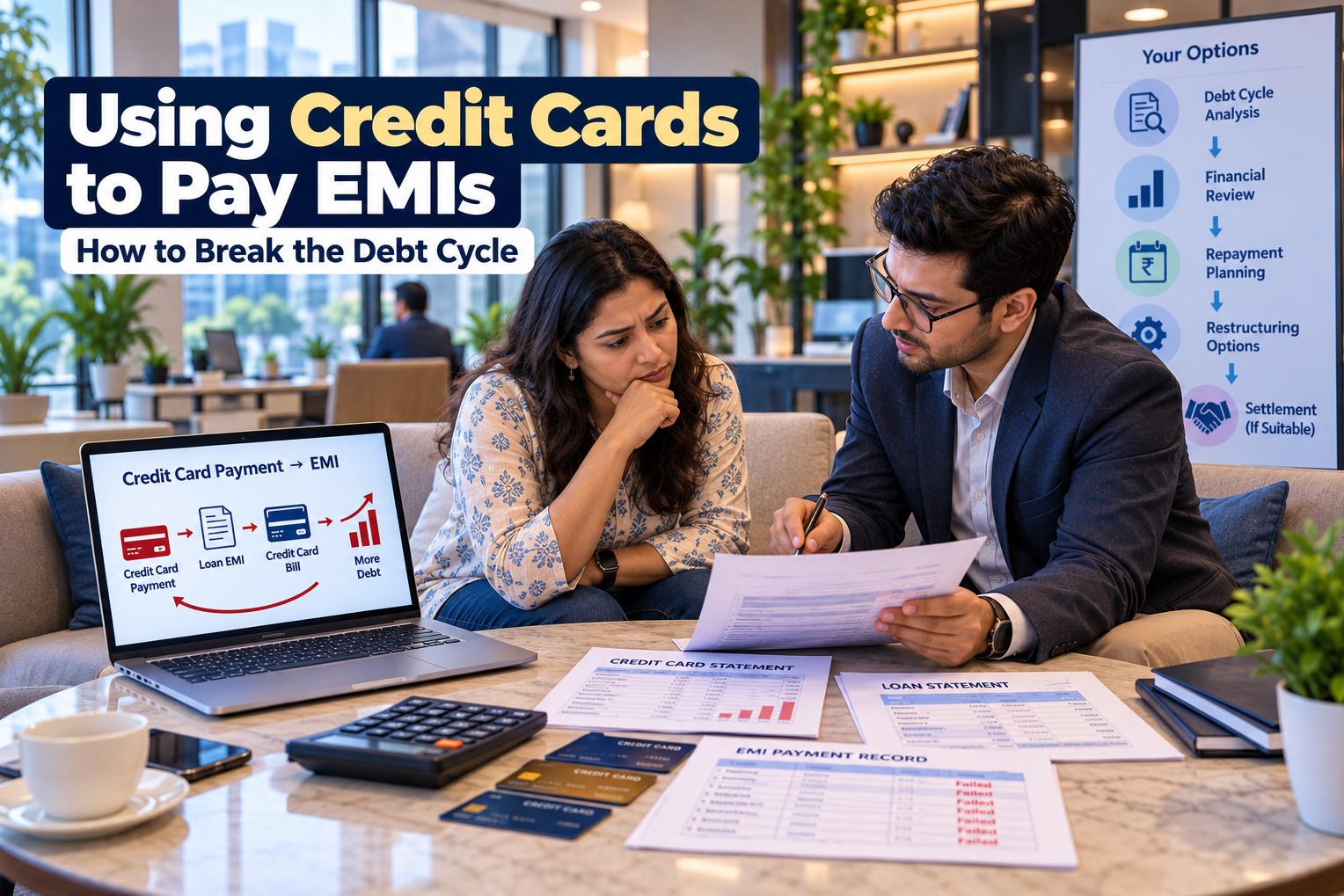
Using a credit card to pay an existing loan EMI can provide short-term relief, but repeatedly doing so can create a costly debt cycle. The borrower may appear to be keeping the loan account current while the actual financial burden shifts to the credit card. Interest, minimum payments, fees and new borrowing can then make the overall debt harder to manage.
If you are using a credit card to fund loan EMIs because your regular income is no longer enough, the first step is to stop treating each EMI as a separate problem. Review all your debts together. Calculate the total monthly repayment obligation, identify the most expensive borrowing, and determine whether the difficulty is temporary or ongoing.
If normal repayment remains affordable, continuing regular payments is generally preferable. If the problem is temporary, restructuring or another repayment arrangement may be worth discussing with the lender. If genuine financial hardship has made full repayment unrealistic, loan settlement may be considered subject to the lender’s approval and applicable policies.
The Short Answer: Should You Use a Credit Card to Pay a Loan EMI?
Using a credit card to pay an existing loan EMI may solve an immediate cash-flow shortage, but it does not remove the underlying debt.
The problem becomes serious when this happens repeatedly:
Loan EMI → Credit Card Borrowing → Credit Card Bill → Another Loan or Credit Card → Higher Monthly Debt
At that point, the borrower is no longer simply managing an EMI. They are using new credit to service existing debt.
A one-time use caused by a temporary timing issue is different from regularly depending on credit cards to meet loan obligations.
If this has become a monthly pattern, review the entire debt position before taking additional credit.
Why This Debt Cycle Develops
Most borrowers do not intentionally create a debt trap. It often develops gradually.
For example, a borrower may have:
- A personal loan EMI of ₹20,000
- Credit card expenses of ₹15,000
- Household expenses of ₹30,000
- Irregular income or reduced salary
One month, the borrower does not have enough cash for the personal loan EMI. The credit card appears to provide a convenient solution.
The EMI is paid.
The immediate problem disappears.
But the next credit card bill arrives.
If the borrower cannot pay the card bill in full, another balance remains. Interest and other applicable charges may increase the cost. The following month, the borrower again faces a cash shortage.
This is how a temporary liquidity problem can become a structural debt problem.
The Difference Between Cash-Flow Management and a Debt Trap
Not every use of a credit card indicates financial distress.
Consider two situations.
Temporary cash-flow mismatch
A salaried employee receives salary on the 5th, but an EMI is due on the 2nd. The borrower uses available funds temporarily and clears the card balance in full when salary arrives.
This may be a short-term timing issue.
Continuing repayment shortage
Another borrower has been using credit cards for several months because salary is insufficient to cover EMIs and household expenses. The borrower is paying one credit card using another source of credit and carrying outstanding balances.
This is a warning sign.
The second situation requires a complete debt review rather than another short-term borrowing solution.
Signs That You Are Stuck in a Credit Card Debt Cycle
Look beyond the number of credit cards you hold.
The following signs deserve attention:
- You use a credit card to pay loan EMIs regularly.
- You pay only the minimum amount on credit cards.
- Your total outstanding debt increases every month.
- You take new loans to repay old loans.
- You use one credit card to manage another card’s payment.
- Your salary is largely committed to EMIs and debt payments.
- You delay essential expenses to make debt payments.
- You have started missing EMI or credit card payments.
- You are receiving repeated collection or repayment communications.
- You cannot explain how the total outstanding amount keeps increasing.
One sign alone does not prove that settlement is required. Several signs together indicate that the current repayment strategy may not be sustainable.
What Should You Do Before Considering Loan Settlement?
Do not jump directly from credit-card borrowing to settlement.
Start with a complete debt assessment.
1. List every outstanding debt
Write down:
- Personal loans
- Credit card balances
- Consumer loans
- Vehicle loans
- Business borrowing
- App-based loans
- Informal borrowing, if relevant
- Any other monthly debt obligation
Record the outstanding amount and monthly payment for each.
2. Calculate your total monthly debt obligation
Add all EMIs and required credit card payments.
Then compare that amount with your reliable monthly income.
Do not use your best earning month for this calculation. Use a realistic income figure.
3. Stop adding unnecessary debt
If you continue borrowing while trying to solve the existing problem, the debt assessment becomes harder.
Avoid taking a new loan simply because it provides another month of temporary relief unless you have calculated the complete cost and repayment ability.
4. Separate essential expenses from discretionary spending
Rent, food, utilities, education, medical expenses and necessary transportation should be considered separately from optional spending.
The purpose is not to eliminate every personal expense. It is to determine how much money is genuinely available for debt repayment.
5. Identify the most expensive debt
Credit card borrowing can become particularly expensive when balances are carried rather than paid in full. Review the applicable interest, fees and repayment terms before deciding which liability requires immediate attention.
Should You Pay the Loan EMI or the Credit Card First?
There is no universal answer because the correct approach depends on the loan agreement, payment status, interest cost and consequences of missing each obligation.
However, borrowers should not automatically use one form of credit to keep another account current.
If the loan EMI is affordable from income, paying it from regular cash flow is generally preferable to funding it with another expensive form of credit.
If neither the loan EMI nor the credit card balance is affordable, the problem is larger than one payment.
This is the point at which a complete debt strategy becomes important.
When Does Loan Settlement Become Relevant?
Loan settlement may become relevant when a borrower is facing genuine financial hardship and cannot realistically repay the full contractual outstanding amount.
Examples may include:
- Long-term loss of income
- Significant reduction in business income
- Major increase in unavoidable household expenses
- Multiple debts consuming available income
- Repeated use of credit to pay existing EMIs
- Persistent repayment difficulty despite reasonable cost-cutting
- No practical ability to maintain the existing repayment schedule
Settlement is not a reward for missing payments.
It is a negotiated resolution that requires lender approval.
The lender may consider the borrower’s circumstances, account status, internal policy and other relevant factors.
Settlement Is Not the Same as Loan Closure
This distinction is important.
When a borrower pays the full amount according to the agreed loan terms, the account may be reported as closed once the lender completes the relevant process.
A settlement generally involves an agreed amount that resolves the account for less than the full contractual dues, subject to the lender’s approval.
The way the account is reported to Credit Information Companies can therefore differ.
A borrower considering settlement should understand the effect on future borrowing before accepting the arrangement.
What Does RBI Say About Compromise Settlements?
The Reserve Bank of India has a framework dealing with compromise settlements and technical write-offs for regulated entities.
A compromise settlement can involve an arrangement where a regulated entity agrees to settle its claim for an amount different from the total amount due, subject to applicable requirements and the entity’s approved policy.
This does not mean that RBI guarantees settlement for a borrower.
There is also no single RBI-prescribed percentage at which all loans can be settled.
Settlement decisions can depend on the lender, loan type, account circumstances, recovery stage, security and applicable internal policies.
Borrowers should therefore be cautious about anyone promising a guaranteed settlement percentage.
What Happens to Your Credit Profile?
Breaking the debt cycle should include a long-term credit strategy.
Using a credit card to pay an EMI does not automatically create a negative credit entry simply because the source of payment was a credit card. The larger issue is whether the credit card and loan obligations are subsequently paid on time.
Repeated missed payments can affect the borrower’s credit history.
If a loan is settled rather than fully repaid under its contractual terms, the account may be reported differently from a normally closed account. This can affect how future lenders assess the borrower.
That is why borrowers should consider CIBIL Score After Loan Settlement as part of the decision, rather than looking only at the immediate reduction in outstanding debt.
A Realistic Indian Example
Consider Rahul, a salaried employee earning ₹60,000 per month.
His monthly commitments include:
- Personal loan EMI: ₹18,000
- Credit card outstanding: ₹40,000
- Other household expenses: ₹25,000
After an unexpected expense, Rahul does not have enough money for the personal loan EMI.
He uses his credit card to manage the payment.
The next month, the credit card bill becomes another liability. Rahul pays part of it and again faces a cash shortage. He then considers another credit facility.
After several months, Rahul has not solved the original cash-flow problem. He has moved the problem between different credit accounts.
At this stage, simply finding another source of money may make the situation worse.
Rahul should instead:
- Stop unnecessary new borrowing.
- List all outstanding debts.
- Calculate his actual monthly repayment capacity.
- Contact the relevant lenders.
- Ask whether restructuring or another repayment arrangement is available.
- Consider settlement only if full repayment is genuinely unrealistic.
- Understand the credit-reporting consequences before accepting settlement.
This is the difference between managing an EMI and managing the underlying debt problem.
Can Restructuring Be Better Than Settlement?
Sometimes, yes.
Restructuring may be worth discussing when the borrower expects to recover financially but needs temporary repayment relief.
Depending on the lender and circumstances, restructuring could involve changes to repayment terms or another approved arrangement.
Settlement becomes more relevant when the borrower does not expect to regain sufficient repayment capacity to clear the full obligation.
The decision should therefore be based on future affordability, not just today’s outstanding amount.
A Simple Decision Framework
Ask these questions in order:
Q1. Can I repay all EMIs from my regular income without borrowing again?
If yes, regular repayment is generally the cleaner option.
Q2. Is my financial problem temporary?
If yes, discuss suitable repayment relief or restructuring with the lender.
Q3. Am I repeatedly using credit cards or new loans to pay existing debt?
If yes, stop and calculate the complete debt burden.
Q4. Can I realistically repay the full outstanding amount within a reasonable period?
If yes, focus on a sustainable repayment plan.
Q5. If not, have I discussed available resolution options with the lender?
If full repayment is genuinely unrealistic, settlement may be one option to evaluate.
Common Mistakes to Avoid
Paying only minimum amounts indefinitely
Minimum payments can keep an account active while allowing the outstanding balance to remain for a long period.
Taking another loan without calculating total cost
A lower EMI does not necessarily mean lower total borrowing cost.
Using credit cards to hide cash-flow problems
A credit card can delay the problem without solving it.
Waiting until every account becomes overdue
Early communication with lenders can provide more options than waiting until the situation becomes severely distressed.
Assuming settlement will automatically be approved
Settlement is subject to lender approval.
Paying an unofficial settlement amount
Do not transfer money to an individual’s personal account based only on a phone call or message.
Ignoring credit consequences
Immediate debt reduction should not be considered separately from future access to credit.
What Documents Should You Prepare?
If you are discussing repayment difficulty or settlement, keep a complete financial file.
Useful documents may include:
- Latest loan statements
- Credit card statements
- Bank statements
- Salary slips
- Income proof
- Business income records, if self-employed
- Existing EMI schedule
- Payment history
- Evidence of significant financial hardship, where applicable
- Previous communication with lenders
- Settlement proposals or letters
Having accurate documents helps distinguish the actual debt from estimates made from memory.
How to Discuss the Problem With Your Lender
Avoid saying only, “I cannot pay.”
Explain the situation clearly.
For example:
“I have been using credit to manage my monthly EMI because my current income is not sufficient to maintain all debt payments. I want to resolve the account and would like to understand the repayment options available under your policy.”
This communicates that the borrower wants a structured solution rather than simply avoiding payment.
If settlement is discussed, ask for the terms in writing.
Check:
- Settlement amount
- Payment deadline
- Loan account number
- Conditions attached to the settlement
- Treatment of remaining dues
- Expected account status after payment
- Payment channel
- Documentation to be issued after payment
How to Break the Cycle Permanently
Settlement alone does not prevent future debt problems.
After resolving the immediate loan issue, review why the credit cycle started.
Possible causes include:
- EMI burden that was too high for income
- Unplanned borrowing
- Excessive credit card spending
- Insufficient emergency savings
- Variable business income
- Medical or family expenses
- Multiple loans taken within a short period
The long-term goal should be to avoid replacing one unaffordable liability with another.
If a borrower settles one loan but immediately takes new credit to meet living expenses, the underlying problem remains.
Frequently Asked Questions
1. Can I use a credit card to pay my personal loan EMI?
Whether a credit card can directly be used for an EMI depends on the lender and payment method. Even where a workaround or permitted facility exists, borrowers should consider the cost because they are using one form of credit to service another.
2. Is using a credit card to pay EMI a debt trap?
Not automatically. A one-time payment caused by a temporary cash-flow mismatch is different from repeatedly using credit to pay existing debt. Regularly borrowing to meet EMIs is a warning sign.
3. Can I settle a loan if I have been paying EMIs through credit cards?
You may request settlement if you are facing genuine financial hardship and cannot realistically repay the loan. However, the lender decides whether to approve settlement.
4. Should I stop paying my loan before requesting settlement?
Do not deliberately stop payments merely to force a settlement. Understand the consequences of missed payments and discuss your situation with the lender before taking such a step.
5. Will loan settlement remove my credit card debt too?
No. Settling one loan does not automatically settle other liabilities. Credit card balances remain separate obligations unless the relevant card issuer agrees to another arrangement.
6. Is debt consolidation better than settlement?
It can be in some situations, particularly when the borrower has stable income and can afford the consolidated repayment. But consolidation is not useful if the new repayment itself remains unaffordable.
7. Does loan settlement affect CIBIL?
A settled account can affect the borrower’s credit profile differently from an account fully repaid under the original terms. Before settlement, understand how the account is expected to be reported to Credit Information Companies.
8. Can RBI force a bank or NBFC to accept my settlement request?
No. RBI’s regulatory framework does not mean that every borrower has an automatic right to settlement. The lender evaluates settlement under its applicable policy and regulatory requirements.
9. What is the biggest warning sign of a credit card debt cycle?
One of the clearest warning signs is repeatedly taking new credit to make payments on existing credit while the total debt continues increasing.
10. Should I pay the credit card or personal loan first?
There is no single answer for every borrower. Consider payment due dates, interest costs, overdue status and the consequences of missing each obligation. If neither payment is affordable, seek a broader debt-resolution strategy instead of shifting money between accounts.
11. Can I negotiate loan settlement myself?
You can communicate directly with your lender and request available resolution options. If the situation involves multiple debts or legal/recovery complications, professional financial or legal guidance may help you understand the documentation and implications.
12. What should I do if I have multiple loans and credit card dues?
Create one consolidated debt list, stop unnecessary new borrowing, calculate your total monthly obligation and assess whether regular repayment remains realistic. Then discuss restructuring, repayment or Debt Settlement options with the relevant lenders.
Final Takeaway
Using a credit card to pay an existing EMI may feel like a solution because it prevents an immediate missed payment. But when it becomes a repeated habit, the borrower may simply be moving debt from one account to another.
The first priority is to identify whether the problem is a temporary cash-flow shortage or a continuing inability to repay.
If regular repayment is affordable, avoid unnecessary borrowing and continue the loan according to its terms. If the difficulty is temporary, discuss restructuring or other repayment arrangements with the lender. If the borrower has genuine continuing financial hardship and full repayment is no longer realistic, Loan Settlement may be considered subject to lender approval.
The goal should not be to find another credit card to pay the next EMI. The goal is to create a repayment strategy that stops the cycle.
A complete review of loans, credit card balances, income, essential expenses and future repayment capacity can help a borrower decide whether repayment, restructuring, consolidation or settlement is the most appropriate path.
For borrowers already struggling with multiple obligations, an expert debt review can help identify the actual source of the problem before another borrowing decision is made.