
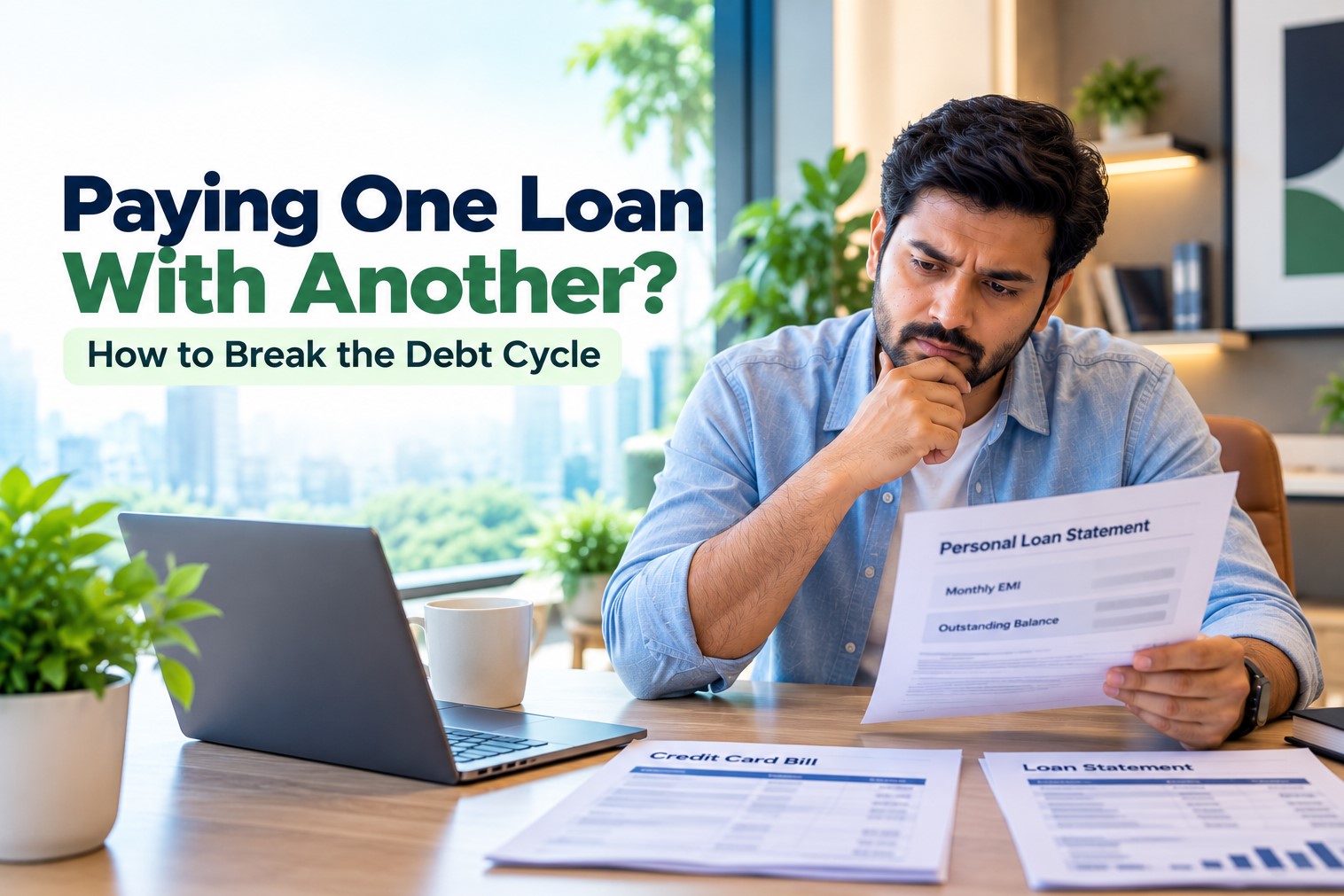
Paying one loan by borrowing from another may help you manage an urgent EMI, but it can become a serious financial problem when the new borrowing has no clear repayment plan. You may end up paying interest on multiple loans while your total outstanding debt continues to grow.
If you are using a personal loan, credit card, loan app or money borrowed from another source to pay existing EMIs, start by calculating your total debt, monthly repayments and actual repayment capacity. Identify which payments are overdue, compare the cost of each loan and stop taking additional credit merely to postpone the same problem.
The right solution depends on your financial position. You may be able to recover through budgeting, a revised repayment schedule or suitable debt consolidation. If genuine financial hardship makes repayment unsustainable, you can also discuss loan settlement options with your lender.
However, settlement is not automatic, and borrowing more money to fund a settlement can make your position worse. Before deciding to settle a loan, understand the outstanding amount, possible credit-reporting consequences and the written terms offered by the lender.
How Does the Loan Trap Begin?
A loan trap develops when a borrower repeatedly takes new credit to meet existing repayment obligations without enough income to reduce the total debt.
It often begins with a temporary problem. An unexpected medical expense, reduced salary, delayed business payment or job loss leaves insufficient money for an EMI. The borrower takes a short-term loan or uses a credit card to avoid missing the payment.
The next month, the original EMI is still due, but the borrower must also repay the new borrowing. Interest, processing fees and other applicable charges increase the overall burden. If income does not improve, the borrower may take another loan to cover both obligations.
This creates a cycle:
Existing EMI → New borrowing → Additional repayment obligation → Monthly cash shortage → More borrowing
The key warning sign is not simply having multiple loans. It is having to borrow repeatedly because your regular income cannot cover your existing repayments and essential expenses.
Warning Signs That You Are Paying One Loan With Another
Review your recent transactions and monthly budget. The following signs suggest that the arrangement may no longer be sustainable.
- You take a new personal loan to pay an existing loan’s EMI.
- You use a credit card for household expenses because your salary is already committed to EMIs.
- You withdraw cash from a credit card to pay another lender.
- You repeatedly use loan apps for small amounts before salary day.
- Your total outstanding debt is increasing even though you make regular payments.
- You have started missing essential expenses to keep loan accounts current.
- You depend on future borrowing to repay the money you borrow today.
One incident does not necessarily mean you are in a debt trap. The concern is a repeated pattern without a realistic plan to repay the new borrowing.
If several of these signs apply to you, calculate the full position before applying for another loan.
Why Taking Another Loan Can Make the Problem Worse
A new loan can appear helpful because it provides immediate cash. But the real question is whether it reduces your total repayment cost and makes the monthly budget sustainable.
You add another EMI
Suppose your existing personal loan EMI is ₹12,000. You take another loan with an EMI of ₹5,000 to manage a cash shortage. Your monthly loan obligations may now rise to ₹17,000, excluding credit card dues and other borrowing costs.
If your salary remains unchanged, you have less money available for rent, food, transport and household needs.
Interest and fees increase the total cost
The new loan may carry a higher interest rate or additional fees. Credit card cash advances and short-term borrowing can be particularly expensive. Always check the interest rate, applicable charges, repayment period and total amount payable.
Do not compare loans only by their EMI. A lower monthly payment may come from a much longer tenure and could increase the total interest paid.
You delay the underlying problem
Using fresh credit may prevent an immediate missed payment, but it does not correct a lasting gap between income and expenses. If the next salary still cannot cover your obligations, you may need to borrow again.
Your credit profile may come under pressure
Repeated credit applications, high credit utilisation, missed payments and overdue accounts can affect how lenders assess your creditworthiness. The effect depends on your complete credit history and the information reported by lenders to Credit Information Companies.
Borrowing more to protect your credit score can therefore become counterproductive if it leads to further unaffordable repayments.
What Should You Do First? Calculate Your Real Debt Position
Before considering settlement, prepare a single list of all your loans and credit obligations. Do not rely on memory or the EMI amounts alone.
For each account, record:
- Lender’s name and type of loan
- Current outstanding amount
- Monthly EMI or minimum payment
- Interest rate and remaining tenure
- Overdue amount, if any
- Applicable fees and charges
- Whether the account is current or in default
Next, calculate your monthly take-home income and essential expenses. Include rent, food, utilities, school fees, transport, medical costs and other necessary household spending.
The amount left after essential expenses is the starting point for deciding how much you can reasonably pay towards debt.
For example, if your monthly take-home income is ₹45,000, essential expenses are ₹22,000 and total loan repayments are ₹28,000, your monthly budget has a shortfall of ₹5,000. Taking another loan may cover one month’s gap, but it will not solve the problem unless your income increases, expenses reduce or repayment obligations change.
Use your actual figures rather than assuming that future borrowing will remain available.
Five Steps to Break the Debt Cycle
1. Stop Taking Fresh Loans Without a Repayment Plan
Avoid applying for another loan simply to pay the next EMI. If you are considering a new loan to replace existing debt, compare the full cost and repayment conditions first.
A consolidation loan may be useful in some circumstances, but only if you qualify for suitable terms and can afford the revised payment. It should not be used to create room for more borrowing.
2. Protect Essential Household Expenses
Your repayment plan must leave enough money for basic needs. Do not commit your entire salary to EMIs if doing so forces you to borrow again for groceries, rent or transport.
Separate essential expenses from discretionary spending. Reduce avoidable expenses where possible, but do not assume that cutting small purchases will solve a major gap between income and debt.
3. Contact Your Lenders Early
If you expect difficulty paying an upcoming EMI, contact the lender before the account falls further behind. Explain your financial position and ask what repayment arrangements may be available.
Depending on the lender’s policy and your circumstances, you may be able to discuss a revised repayment schedule, restructuring or another suitable option. Approval is not guaranteed, so request the available terms in writing.
If you have several lenders, make a separate record of each conversation and any proposal received.
4. Prioritise Repayments Carefully
Where you can afford to make payments, consider the cost of each debt, overdue status and consequences of non-payment. High-cost credit card debt may deserve particular attention, but do not ignore other loans with serious contractual or legal implications.
Continue meeting agreed payments where possible while you seek clarification or negotiate. If you cannot pay every obligation, communicate with the affected lenders and obtain appropriate financial or legal advice instead of making promises you cannot keep.
5. Choose a Sustainable Long-Term Option
Once you understand your total debt and available monthly surplus, compare repayment, restructuring, consolidation and settlement.
A suitable option should reduce the risk of repeated borrowing. The objective is not simply to make this month’s EMI; it is to choose a plan you can realistically maintain.
Loan Repayment, Restructuring, Consolidation or Settlement?
These options solve different problems. Choose based on affordability, total cost and the terms available to you.
Continue regular repayment
This may be the most suitable choice when your income can cover your EMIs and essential expenses, and the debt is reducing according to the repayment schedule.
If you have temporary cash-flow pressure, review your budget and avoid unnecessary new borrowing. Check how extra payments will be applied before making additional principal payments.
Request loan restructuring
Restructuring involves changing repayment terms because of financial difficulty, subject to the lender’s policy and applicable requirements. It may involve a revised instalment amount, tenure or other permitted changes.
A lower EMI can provide short-term relief, but a longer repayment period may increase total interest. Ask for a revised schedule and compare the full repayment cost before agreeing.
Consider debt consolidation
Debt consolidation combines eligible existing debts into a new facility or repayment arrangement. It may simplify payments and, in suitable cases, reduce borrowing costs.
Compare the interest rate, processing fees, tenure, total payable amount and any security required. Do not assume that approval is guaranteed or that a new loan will always be cheaper.
If the new loan does not reduce the overall cost or produce an affordable EMI, consolidation may only postpone the problem.
Discuss loan settlement
Debt settlement involves negotiating with a lender to resolve a debt on agreed terms, potentially for less than the full contractual amount due. It may be considered when genuine financial hardship makes repayment under the original terms unsustainable.
The Reserve Bank of India has issued a framework for compromise settlements and technical write-offs that applies to the regulated entities covered by the relevant instructions. These settlements remain subject to applicable requirements and the lender’s approved policy. The framework does not give every borrower a right to demand a reduced amount or a fixed settlement percentage.
If you are considering Personal Loan Settlement, prepare your income details, essential expenses, total liabilities and a realistic estimate of the funds you can arrange. Explain why the existing repayment plan is no longer affordable.
Before paying, obtain an authorised written settlement letter that specifies the agreed amount, deadline, payment conditions and treatment of the remaining dues. Do not take another expensive loan to fund the settlement unless you have carefully assessed whether doing so is genuinely affordable and beneficial.
Practical Example: When Borrowing Becomes a Monthly Routine
Consider Rahul, a salaried employee in Delhi. He has a personal loan with a monthly EMI of ₹10,000 and credit card dues from earlier expenses. After an unexpected family expense, he takes a short-term loan to pay his personal loan EMI.
The following month, Rahul must pay the original EMI and the new loan instalment. His salary does not cover both payments along with household expenses, so he uses his credit card for daily purchases. The next credit card bill is higher, and he considers another loan.
At this stage, Rahul lists all his outstanding debts and discovers that his monthly obligations exceed the amount available after essential expenses. Instead of applying for another loan, he contacts his lenders, asks about repayment options and creates a budget based on his actual income.
One lender may offer a revised repayment arrangement, while another may not. Rahul compares the available terms and considers settlement only if repayment remains unsustainable.
The lesson is that the first loan was not the only problem. The repeated borrowing created additional obligations that Rahul could no longer manage.
How Loan Settlement Can Affect Your Credit History
Loan settlement may have consequences for your credit profile. A lender may report an account as “settled” rather than as fully repaid and closed under the original terms. Future lenders may view a settled account less favourably when assessing new credit applications.
The impact depends on your overall credit history, the account status reported and the lender’s own assessment. Settlement does not guarantee that your credit score will recover within a fixed period or that future loans will be approved.
Before agreeing to settle, ask how the account will be reported to Credit Information Companies. After completing the written settlement terms, keep the payment receipts and settlement confirmation. Review your credit report and raise a dispute if the reported information is inaccurate.
Read more about CIBIL Score After Loan Settlement if you need to understand the difference between settlement and full repayment.
RBI Guidance and Important Legal Considerations
RBI’s framework recognises compromise settlements as one way regulated lenders may resolve stressed accounts, subject to the applicable rules and internal policies. It also distinguishes a compromise settlement from a technical write-off.
A technical write-off is an accounting treatment; it does not, by itself, waive the lender’s claim against the borrower. Borrowers should therefore not assume that a loan has been cancelled simply because an account is described as written off.
If your debt is subject to a court case, arbitration, recovery proceedings or security enforcement, settlement may involve additional legal considerations. Any arrangement should be checked against the applicable proceedings and documented correctly.
If a lender or intermediary promises guaranteed settlement, a fixed discount or automatic removal of negative credit information, treat the claim cautiously. Verify the authority of the person making the offer and obtain written terms directly from the lender.
Mistakes That Keep Borrowers Trapped in Debt
- Taking a new loan without calculating total cost: A lower EMI can hide a higher overall repayment burden.
- Paying only the minimum credit card amount indefinitely: Interest and other applicable charges can keep the outstanding balance high.
- Ignoring lender communication: Unanswered notices and overdue accounts may make the situation harder to resolve.
- Using a loan app for every cash shortage: Frequent short-term borrowing can add fees, repayment deadlines and further pressure.
- Assuming settlement is guaranteed: Lenders are not generally required to accept every settlement proposal.
- Paying an intermediary without written confirmation: Verify the settlement directly with the lender and keep proof of every payment.
Frequently Asked Questions
1. Is paying one loan with another loan always a bad decision?
Not always. Replacing expensive debt with a lower-cost facility may be reasonable if the terms are suitable and you can afford the new repayment. It becomes risky when you repeatedly borrow because your income cannot cover existing obligations.
2. Should I take a personal loan to clear my credit card dues?
Only after comparing the effective interest rate, fees, tenure and total repayment cost. A personal loan may cost less than revolving credit card debt in some cases, but taking it without changing spending and repayment habits can create additional debt.
3. What if my salary is not enough to pay all my EMIs?
Calculate essential expenses and all debt obligations, then contact your lenders early. Ask about available repayment arrangements and seek qualified advice if you face legal notices or cannot meet basic expenses. Avoid promising payments you cannot afford.
4. Can I settle multiple loans together?
You can discuss each account with the relevant lender, but there is no guarantee that all lenders will agree to settlement or offer the same terms. Obtain separate written confirmation for each account and check whether the proposed payments are realistic.
5. Does loan settlement clear the entire debt?
A settlement resolves the lender’s claim according to the agreed written terms. Do not assume that an application, verbal promise or partial payment clears the account. Confirm the exact conditions and obtain proof after completing them.
6. Can I use a new loan to pay a settlement amount?
It may be possible, but borrowing to fund settlement can simply replace one obligation with another. Compare the new loan’s total cost and monthly payment with your current financial capacity before considering it. Do not proceed if it is likely to restart the debt cycle.
7. Will a lender agree to restructure my loan?
A lender may consider restructuring under its policy and applicable rules, but approval depends on your circumstances and the viability of the proposed repayment plan. Request written terms and check the total amount payable before accepting.
8. How do I know whether debt settlement is suitable for me?
Settlement may be worth discussing when genuine financial hardship makes full repayment unsustainable and other realistic options do not solve the problem. Review your income, expenses, outstanding debt, legal position and credit-reporting consequences before deciding.
9. Does a technical write-off mean I no longer owe the money?
No. A technical write-off is an accounting treatment and does not automatically waive the lender’s claim. Check the actual account status and obtain written confirmation of any settlement or closure.
Break the Cycle Before It Becomes Harder to Manage
If you are paying one loan by borrowing from another, the first priority is to understand why your income cannot cover your current obligations. Calculate your total debt, stop unnecessary borrowing, communicate with lenders and compare repayment options using the full cost—not just the EMI.
If repayment is still unaffordable after a realistic review, discuss restructuring or Debt Settlement with the relevant lender. Settlement should be considered carefully because it may affect your credit history and requires clear written terms.
A sustainable solution is one that fits your actual financial capacity and reduces dependence on future borrowing. Do not take another loan simply to postpone the same shortfall.